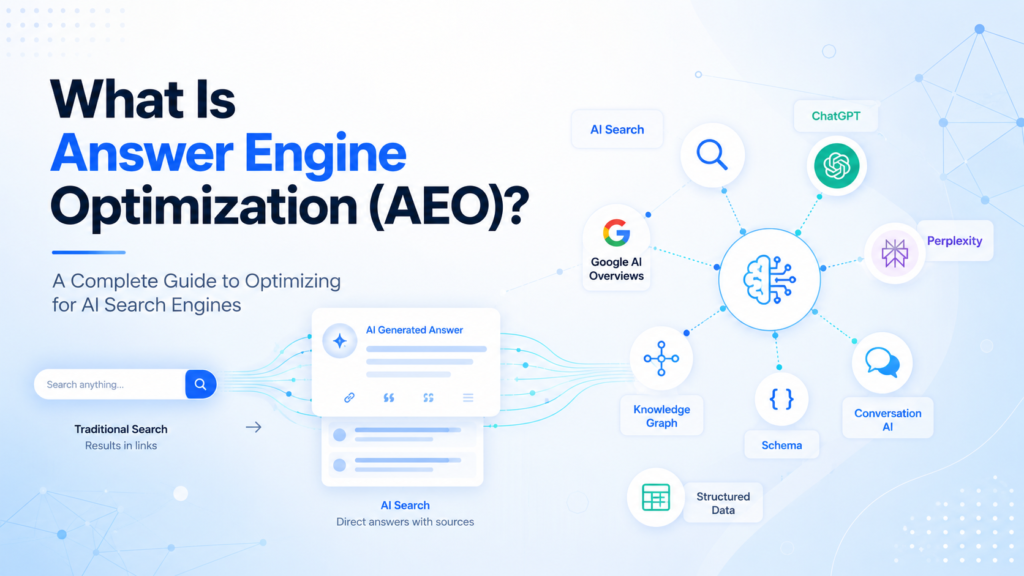
Answer Engine Optimization is the practice of structuring content so AI systems like ChatGPT, Google AI Overviews, Claude, Perplexity, and Gemini can understand it, trust it, and use it to generate direct answers to user questions.
People are no longer searching only on Google. Millions now ask ChatGPT, Google AI Overviews, Claude, Perplexity, Gemini, and voice assistants directly. Instead of showing up as a ranked webpage someone has to click, businesses now need to become the answer itself.
In this guide, you’ll learn what AEO is, why it matters, how AI search actually works, the difference between SEO and AEO, the ranking factors that influence AI citations, a full optimization process, the tools worth using, common mistakes, and where this is all heading.
What Is Answer Engine Optimization (AEO)?
Quick answer: AEO is the process of optimizing content so AI-powered answer engines can retrieve it, understand it, and cite it directly in a generated response, rather than simply linking to it in a list of search results.
It applies across AI platforms including ChatGPT, Google AI Overviews, Google AI Mode, Perplexity, Claude, Gemini, Microsoft Copilot, and voice assistants like Siri and Alexa. In each case, the AI reads through available content, decides which sources are trustworthy and relevant, and generates a synthesized answer, sometimes with citations attached.
This is a fundamentally different goal than traditional SEO.
Traditional search: Search → Websites → User clicks
AI search: Question → AI → Direct Answer → Source Citation
In traditional search, ranking high is the finish line. In AI search, ranking high doesn’t guarantee anything. The AI still has to choose to extract your content, trust it enough to use it, and decide it’s worth citing over a competitor’s page covering the same topic.
Why Is Answer Engine Optimization Important?
The shift toward AI-mediated search isn’t a future trend. It’s already reshaping how people find information and make decisions.
A growing share of search queries now end without a click at all, resolved entirely inside an AI-generated answer. Google’s AI Overviews now appear across a significant portion of search results. ChatGPT has become a default research and recommendation tool for millions of people, many of whom now ask it the kinds of questions they used to type into Google. Perplexity has built its entire product around cited, conversational answers. Voice assistants have quietly normalized asking a question out loud and expecting a spoken answer, not a list of links.
This matters because organic traffic alone is no longer a complete picture of visibility. A business can lose visibility inside AI-generated answers while still holding steady or even improving in traditional rankings, because the two systems evaluate content differently. Waiting for that data to show up as a traffic drop is waiting too long. AEO is how you optimize for the layer of discovery that’s growing fastest.
How Answer Engines Work
Understanding the mechanics behind AI search makes the rest of this guide much easier to apply.
Crawling. AI systems still rely on crawled content, either through their own crawlers or by querying existing search indexes in real time. If your content isn’t crawlable, none of the rest matters.
Indexing. Once crawled, content gets stored and organized so it can be retrieved quickly when relevant.
Retrieval. This is where AI search diverges most from traditional search. Instead of just matching keywords, AI systems use vector search and embeddings, mathematical representations of meaning, to find content that’s semantically related to a query, even if the exact words don’t match. This is combined with knowledge graphs, which map how entities (people, companies, products, concepts) relate to one another.
Understanding intent. Large language models use natural language processing to interpret what a person is actually asking, factoring in context and, in conversational tools, memory of earlier turns in the conversation.
Answer generation. Most modern AI search tools use retrieval-augmented generation (RAG), a process where the model retrieves relevant source material and then generates a response grounded in that material. This includes selecting sources, scoring how confident the model is in the answer, generating citations, and applying safeguards intended to reduce hallucination (the model stating something false or unsupported).
Each of these steps is a filter. Content has to survive crawling, indexing, retrieval, and generation to end up as a cited answer.
What Platforms Use AEO?
| Platform | How Answers Work | Citation Style | Optimization Focus |
|---|---|---|---|
| ChatGPT | Retrieval-augmented responses, sometimes with live browsing | Inline links when browsing is used | Clear structure, direct answers, entity clarity |
| Google AI Overviews | Pulled from Google’s index, generated above organic results | Linked source cards | Strong existing SEO plus structured, extractable content |
| Google AI Mode | Conversational, multi-step retrieval | Linked sources within the response | Topical depth, semantic relevance |
| Perplexity | Real-time web retrieval with heavy citation emphasis | Numbered inline citations | Fresh, factual, well-sourced content |
| Claude | Retrieval when connected to search or documents | Contextual references | Clarity, accuracy, well-organized explanations |
| Gemini | Integrated with Google’s knowledge graph and search index | Linked source cards | Entity optimization, structured data |
| Microsoft Copilot | Bing-powered retrieval | Numbered citations | Bing-indexed content, structured answers |
| Meta AI | Retrieval within Meta’s platforms | Varies, often unlinked | Broad topical authority |
| Siri | Often pulls from Apple’s search partnerships | Rarely cited aloud | Concise, direct answers |
| Alexa | Pulls from partnered content sources | Rarely cited aloud | Structured data, direct answers |
Difference Between SEO and AEO
| SEO | AEO | |
|---|---|---|
| Ranking goal | Rank on the search results page | Get selected and cited as the answer |
| Traffic | Depends on clicks from ranked positions | May generate visibility and brand recognition without a click |
| Clicks | Central success metric | Secondary; not every citation results in a click |
| Target surface | The SERP | The AI-generated answer itself |
| Content style | Built around keywords and search volume | Built around intent, direct answers, and semantic clarity |
| Authority signals | Backlinks, domain authority | Entities, structured data, topical depth |
| Success metrics | Rankings, organic traffic, CTR | AI citations, brand mentions, AI referral traffic |
AEO doesn’t replace SEO. Most of what makes content rank well in traditional search, crawlability, clear structure, topical relevance, also makes it more retrievable by AI systems. AEO builds on SEO fundamentals and adds a second, more specific layer focused on how content gets extracted and cited rather than just ranked.
SEO vs AEO vs GEO
SEO (Search Engine Optimization) focuses on ranking pages in traditional search engine results, driven primarily by keywords, backlinks, and technical site health.
AEO (Answer Engine Optimization) focuses on getting content selected and cited as a direct answer, typically within a specific answer placement like a featured snippet or AI Overview.
GEO (Generative Engine Optimization) is the broadest of the three, focused on being recommended by name across AI-generated responses on platforms like ChatGPT, Gemini, and Perplexity, not tied to a single answer placement.
Think of them as layers rather than competitors. SEO gets your content crawled and indexed in the first place. AEO gets specific pieces of that content pulled into direct answers. GEO extends that visibility across the broader ecosystem of AI tools people now use as a starting point for research and recommendations. A business chasing long-term visibility needs all three working together, not one instead of the others.
How AI Chooses Sources for Answers
AI systems weigh a combination of signals when deciding which sources to trust and cite:
Content quality, authority, and freshness all factor in, alongside trustworthiness signals like clear authorship and consistent factual accuracy across a site. Structured data helps AI systems parse a page correctly, while entity recognition and semantic relevance determine how well a page matches the actual meaning behind a question, not just its keywords.
Topical authority matters too. A site that consistently and accurately covers a subject earns more trust than one with scattered, shallow coverage. Internal and external links, citations from other credible sources, and demonstrated author expertise all reinforce that trust. Page experience, readability, and original research (data or insights that don’t exist anywhere else) add further weight. Consistency across a brand’s public information, brand mentions elsewhere on the web, and signals tied to knowledge graphs round out the picture.
No single factor guarantees a citation. AI systems weigh these signals together, which is why isolated tactics like adding schema without improving content quality rarely move the needle on their own.
Ranking Factors for Answer Engine Optimization
Helpful content. Content that genuinely answers a question in full, rather than circling around it to increase word count.
E-E-A-T. Experience, expertise, authoritativeness, and trustworthiness. Originally a Google concept, but the same qualities influence AI trust broadly.
Semantic relevance. How closely content matches the actual meaning of a query, not just its keywords.
Entity optimization. Clearly defining who and what your business, products, and people are, so AI systems can place you correctly.
Structured data. Schema markup that confirms page content and structure in a machine-readable format.
NLP optimization. Writing in a way that natural language processing systems can parse cleanly, avoiding overly complex or ambiguous phrasing.
Conversational writing. Matching the tone and phrasing people actually use when talking to AI tools.
Question and answer format. Structuring content around real questions with direct answers.
FAQ structure, lists, tables, definitions, statistics, and citations. All formats that are easy for AI systems to extract cleanly.
Updated information, author pages, topic clusters, and content freshness. Signals that content is current and backed by real expertise.
Crawlability, fast websites, and mobile experience. The technical foundation that makes all of the above possible to retrieve in the first place.
How to Optimize Content for AEO
Step 1: Research questions. Use Google’s “People Also Ask,” Reddit, Quora, ChatGPT, Perplexity, Google Search Console, AnswerThePublic, and AlsoAsked to find the real questions your audience is asking, not just the keywords they type.
Step 2: Identify search intent. Sort those questions into informational, commercial, transactional, or navigational intent, and write content that matches.
Step 3: Write direct answers first. Lead with a 40 to 60 word direct answer to the core question, then follow with detailed explanation, examples, statistics, and sources. This structure mirrors how featured snippets and AI Overviews are generated.
Step 4: Use semantic SEO. Incorporate related entities, synonyms, and adjacent concepts naturally, so the content reads as genuinely comprehensive rather than narrowly keyword-focused.
Step 5: Optimize headings. Use question-based H2s written in natural language, the way a person would actually phrase the question.
Step 6: Build topic clusters. Create a pillar page covering a topic broadly, supported by cluster pages that go deep on specific subtopics, all interlinked.
Step 7: Use schema markup. Implement relevant schema types, including Organization, Person, Article, FAQ, HowTo, Breadcrumb, WebPage, Speakable, Video, Review, Product, and SoftwareApplication, depending on the content type.
Step 8: Improve readability. Short paragraphs, bullet points, tables, and concrete examples in plain language.
Step 9: Add original research. Case studies, real statistics, unique frameworks, and expert opinions that don’t exist anywhere else. This is one of the strongest AI citation signals available, because it can’t be copied from a competitor.
Step 10: Update content regularly. Refresh statistics, reflect new AI platform features, and keep pace with industry changes.
Best Content Formats for AEO
Definitions and glossaries work well because they map directly onto how people phrase questions to AI tools. How-to guides and tutorials give AI systems clean, sequential steps to extract. Comparison articles and listicles are naturally structured for direct extraction. FAQs answer discrete questions in isolation, which is exactly the format AI systems favor. Case studies and statistics pages provide the kind of original, citable data AI systems are drawn to. Ultimate guides, checklists, templates, and calculators all offer practical, structured value that’s easy to reference and hard to replicate.
Best Content Structure for AI Search
A page built for AI retrieval typically follows this shape: a clear H1, a short summary answering the core question immediately, a table of contents for longer pieces, definitions where relevant, question-based sections, concrete examples, supporting visuals, tables where comparison helps, an FAQ section, cited sources, and a concise conclusion.
This isn’t just good practice for AI. It’s also better for human readers who are scanning rather than reading top to bottom.
Schema Markup for AEO
FAQ schema marks up question and answer pairs, often eligible for rich results.
HowTo schema marks up step-by-step instructions.
Article schema confirms authorship, publish date, and content type.
WebPage and Organization schema establish basic entity and page-level context.
Person schema ties content to a specific author’s credentials.
Video and Speakable schema support multimedia and voice-read content.
Product, Software, and LocalBusiness schema apply to ecommerce, SaaS, and local business pages respectively.
Common mistakes include adding schema that doesn’t match the visible content, leaving required fields incomplete, or implementing multiple conflicting schema types on the same page. Validate implementation using Google’s Rich Results Test and Schema.org’s own validator before publishing.
Topical Authority and AEO
Topical authority is built through topic clusters, a pillar page supported by multiple in-depth cluster pages, all interlinked, rather than isolated articles on unrelated subjects. Content hubs organize this structure visibly for both users and crawlers. Strong entity relationships (clearly connecting your brand to the concepts, products, and people it’s associated with) and consistent publishing over time reinforce that authority. A site that publishes five deeply connected articles on one subject typically earns more AI trust than a site that publishes fifty scattered posts on unrelated topics.
How AI Understands Entities
AI systems identify named entities, specific people, companies, products, and concepts, and map them within a knowledge graph that shows how those entities relate to one another. Entity salience measures how central an entity is to a given piece of content, while co-occurrence (which entities consistently appear near each other across the web) helps AI systems build those relationships. Context and disambiguation help resolve ambiguity, such as distinguishing between a company and a person with the same name. Clear, consistent entity information across your website, social profiles, and any third-party mentions strengthens how confidently AI systems can identify and trust your brand.
Conversational Search Optimization
Voice search and conversational AI queries tend to be longer, more natural, and phrased as full questions rather than short keyword fragments. Optimizing for this means writing content that answers long-tail, conversational queries directly, using the phrasing real people use out loud, not the clipped phrasing typical of old-style keyword targeting.
AEO for Local Businesses
Local AEO depends on an accurate, fully optimized Google Business Profile, consistent NAP (name, address, phone) information across the web, local business schema, genuine customer reviews, dedicated location pages for multi-location businesses, and FAQ content addressing common local queries. Voice search plays an outsized role here, since a large share of local queries (“near me,” “open now”) happen through voice assistants.
AEO for SaaS Companies
SaaS businesses benefit most from strong documentation, clear feature pages, transparent pricing pages, comparison pages against competitors, downloadable templates, a well-maintained glossary of industry terms, tutorials, and accessible API documentation. AI tools are increasingly used by potential buyers to compare software options before they ever visit a vendor’s site directly, which makes comparison and documentation content especially high-value.
AEO for Ecommerce Websites
Ecommerce AEO centers on buying guides, product FAQs, complete product schema, comparison pages between similar products, genuine customer reviews, a functioning Q&A section, and detailed specifications. Shoppers increasingly ask AI tools for product recommendations before searching a retailer directly, so structured, specific product information matters more than ever.
AEO for Blogs
Blogs benefit from evergreen content built around real question clusters, consistent authority-building within a specific niche rather than broad coverage, strong internal linking between related posts, and visible author pages that establish real expertise behind the content.
Common AEO Mistakes
Thin content that doesn’t fully answer the question. Keyword stuffing that ignores natural language and semantic clarity. Ignoring entities entirely, leaving AI systems unable to confidently identify who or what your business is. Publishing with no schema markup at all. Weak introductions that bury the direct answer under unnecessary preamble. Duplicate content across pages. Outdated information that contradicts more current sources. Poor site experience that undermines otherwise strong content. Missing FAQ sections on pages that would clearly benefit from them. And, most simply, ignoring AI search altogether while continuing to optimize only for traditional rankings.
Best AEO Tools
| Tool | Purpose | Free/Paid | Best For |
|---|---|---|---|
| ChatGPT | Query research, content testing | Free/Paid tiers | Understanding how AI phrases and answers questions |
| Perplexity | Citation and source research | Free/Paid tiers | Seeing which sources get cited for a given query |
| Google Search Console | Search performance monitoring | Free | Tracking impressions, clicks, and indexing issues |
| Google Trends | Topic and query trend research | Free | Spotting rising questions and topics |
| Ahrefs | Backlink and keyword research | Paid | Competitive and technical SEO analysis |
| Semrush | Keyword, competitor, and content gap research | Paid | Broader SEO and content strategy |
| Screaming Frog | Technical site auditing | Free/Paid | Crawlability and technical SEO issues |
| Schema.org | Schema type reference | Free | Understanding available schema types |
| Merkle Schema Generator | Schema markup generation | Free | Building schema without manual coding |
| PageSpeed Insights | Site speed and Core Web Vitals | Free | Technical performance |
| Surfer SEO | Content optimization scoring | Paid | On-page content structure |
| NeuronWriter | Content optimization and NLP terms | Paid | Semantic content optimization |
| AlsoAsked | Related question research | Free/Paid | Mapping question clusters |
| AnswerThePublic | Question and query research | Free/Paid | Early-stage topic research |
How to Measure AEO Success
Track AI citations directly, using tools like Semrush’s AI visibility reporting or manual spot-checks across ChatGPT, Perplexity, and Google AI Overviews. Monitor brand mentions across AI platforms, referral traffic from AI sources (visible in GA4 as referral traffic from domains like chatgpt.com, claude.ai, or perplexity.ai), search impressions, click-through rate, organic traffic, and general search visibility. Watch for appearances in Google’s Knowledge Graph, featured snippets, and AI Overviews specifically. Ultimately, tie all of this back to conversions and lead generation, since visibility alone isn’t the goal, qualified traffic and business results are.
Future of Answer Engine Optimization
AI agents capable of taking multi-step actions on a user’s behalf are becoming more common, which will shift optimization further toward machine-readable clarity rather than just human-readable persuasion. Multimodal search, combining text, image, and voice, will expand what “content” even means for optimization purposes. Personal AI assistants and AI-integrated browsers are moving discovery even further away from a traditional search bar. In some cases, search is starting to disappear entirely, replaced by predictive answers a system offers before a question is even fully asked, and by agentic commerce, where an AI assistant might complete a purchase decision on a user’s behalf.
Businesses preparing for this should treat structured, entity-clear, consistently accurate content as infrastructure, not a one-time project. The businesses that build this foundation now will have a significant head start as these systems keep evolving.
Answer Engine Optimization Checklist
Research
- Define your target audience clearly
- Identify the conversational queries they actually ask
- Map search intent for each target topic
- Build keyword and question clusters
Content
- Write direct answers first, before detailed explanation
- Cover topics comprehensively rather than partially
- Include concrete examples
- Add real statistics
- Cite credible sources
- Use visuals where they add clarity
- Create comparison tables where relevant
Technical SEO
- Improve Core Web Vitals
- Optimize crawlability
- Submit an XML sitemap
- Use canonical tags correctly
- Implement relevant schema markup
Semantic optimization
- Strengthen entity relationships across your site
- Expand topical authority through clusters
- Add internal links between related content
- Use natural, conversational language
Trust signals
- Publish clear author bios
- Showcase real credentials
- Include references and sources
- Display last-updated dates
Monitoring
- Track AI citations across major platforms
- Measure AI referral traffic in analytics
- Monitor featured snippet and AI Overview appearances
- Refresh outdated content regularly
- Review search performance monthly
Key Takeaways
AEO focuses on becoming the answer, not just earning a click. AI platforms prioritize authoritative, semantically rich, well-structured content over content that’s simply keyword-optimized. SEO, AEO, and GEO work best together rather than replacing one another. Direct answers, topical authority, schema markup, and original insights are what actually move the needle on AI visibility. Continuous updates and ongoing performance monitoring aren’t optional extras, they’re essential, since answer engines keep evolving and static content loses relevance quickly.
FAQs
No. AEO builds on SEO fundamentals like crawlability and technical health, and adds an additional layer focused on direct-answer citation.
Yes. AEO typically targets specific answer placements like featured snippets or AI Overviews, while GEO is the broader goal of being recommended by name across AI platforms generally.
Schema improves machine readability, which supports AEO, but it doesn’t guarantee citations on its own. Content quality still matters most.
Yes. AI citation depends more on content clarity and trust signals than on domain authority alone, which levels the playing field somewhat compared to traditional SEO.
Yes, particularly when browsing is enabled or when ChatGPT is trained on or retrieving from indexed web content.
Strong existing SEO combined with clear, direct-answer content structure and supporting schema markup improves the odds, though there’s no guaranteed method.
Initial structural improvements can show results within weeks. Building topical authority and consistent citations typically takes several months.
For most businesses, yes, given how much discovery is shifting toward AI-mediated search.
SaaS, technology, healthcare, finance, and any industry where people research heavily before purchasing tend to see the strongest early results.
Content with direct, specific answers backed by real evidence, clear structure, and demonstrated expertise.
Regularly. Stale statistics and outdated information reduce AI trust over time.
Yes, particularly through buying guides, product schema, and comparison content.
Yes, voice search is one specific surface within the broader AEO discipline.
Yes, though AI systems weigh a broader mix of signals, including entity clarity and content structure, alongside traditional authority signals like backlinks.
Google Search Console, AnswerThePublic, and direct testing within ChatGPT and Perplexity are a solid starting point before investing in paid tools.
Through a combination of author expertise, site consistency, citation history, and structured trust signals like schema and clear sourcing.
Indirectly. Slow sites can hurt crawlability and user experience, which affects the broader trust signals AI systems consider.
Yes, though new sites typically need to demonstrate clear expertise and trust signals faster, since they lack the accumulated authority older domains may have.
Very. Original data and unique frameworks are among the strongest citation signals, since they can’t be found anywhere else.
Through direct citation tracking, AI referral traffic in analytics, and periodic manual testing of relevant queries across major AI platforms.