Search has split into three different games, and most businesses are still only playing one of them.
For close to two decades, ranking on Google was the whole strategy. Now people ask ChatGPT for recommendations, Google shows AI Overviews before any blue links appear, and Perplexity answers questions without a single click to a website. Three disciplines have emerged to deal with this shift: SEO, AEO, and GEO. They overlap, but they are not the same thing, and confusing them is costing businesses visibility they don’t even realize they’re losing.
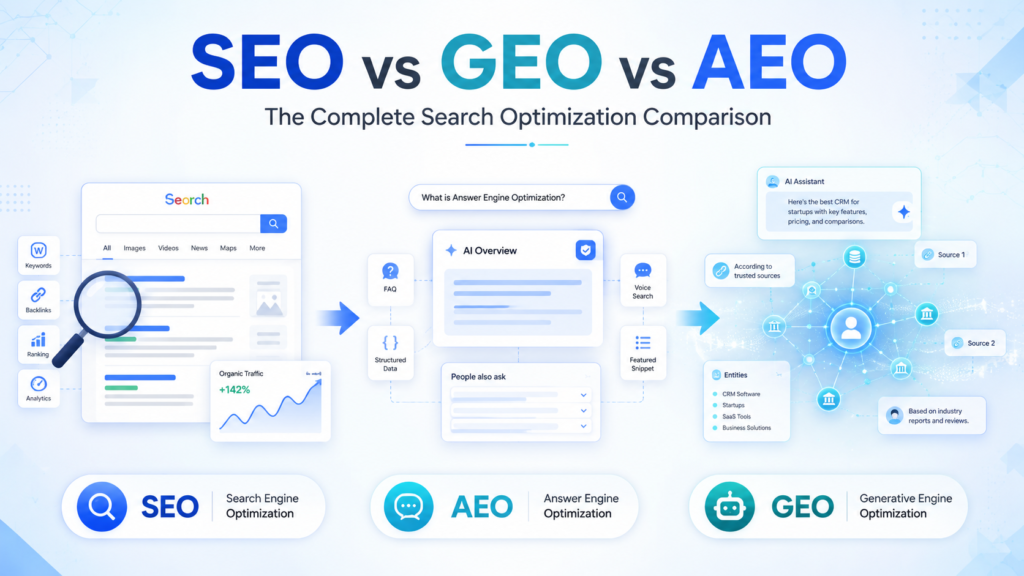
Here is the short version. SEO gets your pages ranked in traditional search engines. AEO gets your content pulled into direct answers like featured snippets and AI Overviews. GEO gets your brand cited and recommended by AI models like ChatGPT, Claude, Gemini, and Perplexity. Most businesses in 2026 need all three working together, not one chosen over the other two.
This article breaks down what each one actually means, how they differ, and how to build a strategy that covers all three without wasting effort.
What is SEO?
SEO, or search engine optimization, is the practice of improving a website so it ranks higher in search engines like Google.
Google’s process is straightforward at a high level. It crawls the web with bots, indexes the pages it finds, and ranks them based on relevance and authority when someone searches. SEO is the work of influencing every step of that process in your favor.
The main goals of SEO are organic traffic, higher rankings for target keywords, and ultimately leads or sales that come from people finding you in search results.
SEO breaks down into a few core components.
Technical SEO covers the backend health of a site. This includes site speed, Core Web Vitals, mobile optimization, and making sure Google can actually crawl and index your pages without hitting errors.
On-page SEO covers what’s on the page itself. Keyword usage, internal linking, schema markup, heading structure, and metadata all fall here.
Off-page SEO is about signals from outside your own site. Backlinks, brand mentions, and digital PR all build the authority Google uses to decide how much to trust you.
Content SEO ties it together. Helpful, well-researched content that demonstrates real expertise, trustworthiness, and topical depth performs better than thin content stuffed with keywords.
SEO is still the foundation. AEO and GEO don’t replace it, they build on top of it.
What is AEO?
AEO, or answer engine optimization, is the practice of structuring content so it becomes the direct answer shown by search engines and AI tools, rather than just another ranked link.
This shows up in a few places: Google AI Overviews, classic featured snippets, voice search results, and Bing Copilot answers. The goal isn’t to rank at position one anymore. It’s to become the actual answer someone sees or hears without having to click through to a website.
AEO exists because zero-click search has become normal. Someone asks a question, gets an answer instantly, and moves on. If your content isn’t structured to be extracted as that answer, you’re invisible even if your page technically ranks well.
The content patterns that win at AEO are predictable. Question-and-answer formatting, concise and direct explanations, FAQ schema, lists, tables, how-to content, and clear definitions all make it easier for search engines to lift your content into an answer box.
What is GEO?
GEO, or generative engine optimization, is the practice of getting AI systems like ChatGPT, Claude, Gemini, and Perplexity to cite, recommend, or mention your brand when generating an answer.
This is a different problem than ranking. AI systems don’t return a list of ten blue links. They generate a synthesized response and decide, on their own, which sources are trustworthy enough to reference or pull information from. Getting cited depends on how these models discover and evaluate sources in the first place, which has much more to do with entities, knowledge graphs, and trust signals than it does with traditional keyword rankings.
Concepts that matter for GEO include brand entity recognition, how well a topic connects into a knowledge graph, entity authority, trust signals scattered across the web, and how frequently and consistently a brand gets cited across independent sources.
It helps to see how we got here.
Traditional search ran from roughly 2000 to 2023, dominated by Google rankings. AI search emerged in 2024 with the arrival of AI Overviews. Conversational search took over in 2025 as ChatGPT, Gemini, and Perplexity became default research tools for a huge number of people. Now, in 2026 and heading further, we’re moving into agentic search, where AI agents don’t just answer questions, they take actions and make decisions on a user’s behalf, choosing which tools, products, or services to use.
How do SEO, AEO, and GEO actually compare?
| Factor | SEO | AEO | GEO |
|---|---|---|---|
| Goal | Rank in search results | Become the direct answer | Get cited by AI models |
| Platform | Google, Bing | AI Overviews, featured snippets, voice | ChatGPT, Claude, Gemini, Perplexity |
| Traffic | Click-through to website | Often zero-click | Often zero-click, brand-driven |
| Ranking | Position-based | Answer-box based | Citation-based |
| Optimization focus | Keywords, links, technical health | Structure, clarity, schema | Entities, trust, authority signals |
| Content style | Long-form, comprehensive | Short, direct, scannable | Authoritative, citation-worthy |
| Structured data | Helpful | Important | Important |
| Brand authority | Backlinks | Featured snippet ownership | AI citation frequency |
| User intent | Informational, transactional | Quick answers | Recommendations, comparisons |
| Measurement | Rankings, traffic, CTR | Snippet visibility | Citation frequency, AI mentions |
| Difficulty | Well understood, competitive | Moderate | Still emerging, less competitive |
| Future importance | Stable | Growing | Growing fastest |
How has the search journey changed?
The old journey was simple. Someone searched on Google, clicked a website, read the article, and eventually purchased.
The new journey looks different. Someone asks ChatGPT a question, receives a synthesized answer, maybe clicks through to a source if one is cited, and then purchases, often without ever visiting a traditional search engine.
That shift is exactly why optimization has to adapt. If a business only optimizes for the old journey, it becomes invisible in the new one.
SEO vs AEO vs GEO, compared directly
SEO focuses on ranking position, backlinks, and traffic. AEO focuses on answer boxes, voice search, and snippet-friendly content structure. GEO focuses on Google rankings versus AI citations, entities and knowledge graphs versus backlinks, and being embedded in an AI model’s understanding of a topic rather than just being linked to from other sites.
People frequently confuse GEO and AEO because both deal with AI-driven results. The distinction is that AEO optimizes for being pulled into a direct answer, while GEO optimizes for being understood and trusted by AI models well enough to be cited or recommended, even outside of a single answer box.
Can a business ignore SEO?
No. This is worth being blunt about.
GEO and AEO both depend heavily on strong SEO foundations. AI models and answer engines still rely on crawlable, well-structured, authoritative content to figure out what to trust. Without solid technical SEO, clean site architecture, and internal linking, there’s very little for GEO or AEO to build on top of.
Can a business rank without GEO?
Yes, in some situations. Local businesses, low-competition industries, and traditional B2B companies with established authority can still perform well using classic SEO alone, at least for now. But that window is closing as more search behavior shifts toward AI tools, even in industries that haven’t felt the impact yet.
Can a brand appear in ChatGPT without doing SEO?
To some degree. Brand mentions, public documentation, community discussions, and general entity recognition can get a brand surfaced in AI answers even without a traditional SEO strategy. But this path is slower and far less controllable than building a proper content and authority foundation, which is where SEO and GEO end up reinforcing each other.
How does AI choose which sources to cite?
AI retrieval systems weigh a combination of signals: trust, authority, freshness, how well a brand’s entity connects to other trusted entities, consistency of information across the web, structured and machine-readable content, and citations from independent third-party sources.
This is fundamentally different from Google’s link-based ranking system, even though there’s overlap. A brand can rank on page one of Google and still be completely absent from an AI-generated answer if it lacks strong entity signals.
What signals matter most for GEO?
The strongest GEO signals include entity authority, brand mentions across the web, digital PR coverage, author reputation, semantic coverage of a topic, topical authority built over time, being cited by others, original research, statistics that get referenced elsewhere, community discussions, reviews, and public documentation.
What signals matter most for AEO?
AEO responds well to FAQ schema, HowTo schema, question-based headings, clear definition boxes, bullet lists, comparison tables, direct and concise answers, simple language, and supporting examples that reinforce the answer.
What signals matter most for SEO?
Classic SEO signals still hold: backlinks, page speed, keyword relevance, matching search intent, content quality, internal linking, and overall user experience on the site.
A real example
Take a search like “best CRM for startups.”
The SEO result looks like a blog post ranking around position two in Google’s results. The AEO result looks like Google’s AI Overview summarizing a comparison of several CRMs in a box above the traditional results. The GEO result looks like ChatGPT directly recommending a specific CRM by name, with a citation back to the source it pulled that recommendation from.
Three completely different outcomes from the same search intent, and a business needs a different kind of visibility to win each one.
Which businesses need SEO, AEO, or GEO most?
SEO tends to matter most for local businesses, blogs, ecommerce stores, publishers, and service-based companies that depend on consistent organic traffic.
AEO tends to matter most for SaaS companies, healthcare, education, finance, B2B companies, and knowledge-heavy websites where people are searching for quick, direct answers.
GEO tends to matter most for startups, software companies, AI tools, technology companies, consultants, agencies, and personal brands, since these are exactly the categories AI models get asked about most often when people want recommendations.
Most businesses fall into more than one of these categories, which is exactly why a combined strategy makes more sense than picking just one.
How do you combine SEO, GEO, and AEO into one strategy?
Start with technical SEO to make sure the site is crawlable, fast, and indexable. Build topical authority by covering a subject in genuine depth rather than a handful of scattered posts. Structure content clearly with question-based headings, lists, and tables so it’s easy for both humans and AI systems to extract. Build out entities through consistent branding, author profiles, and clear information across the web. Invest in digital PR and mentions from credible third parties. Layer in AI-specific optimization like schema markup and citation-worthy original content. Then measure results across all three channels, not just traditional rankings.
What are the most common mistakes businesses make?
The biggest one is treating GEO as a replacement for SEO instead of an extension of it. Beyond that, common mistakes include ignoring technical SEO entirely, keyword stuffing, skipping schema markup, publishing thin AI-generated articles with no real depth, weak or inconsistent branding, no citations or references to build credibility, missing author profiles, and no original research or data that others might want to cite.
What are the pros and cons of each approach?
SEO has the advantage of being well understood, with mature tools and clear measurement, but it’s also the most competitive and slowest to show results in crowded niches.
AEO offers strong visibility for quick-answer queries and can dramatically boost zero-click brand exposure, but it often sends less direct traffic since users get their answer without clicking through.
GEO offers access to a fast-growing channel with comparatively less competition right now, but it’s also the least predictable, with limited tooling and measurement compared to traditional SEO.
How do you measure success in each area?
For SEO, track rankings, organic traffic, click-through rate, and backlink growth.
For AEO, track featured snippet ownership, AI Overview visibility, and voice search presence.
For GEO, track AI citation frequency, brand mentions inside AI-generated answers, referral traffic from AI platforms, and overall AI visibility across tools like ChatGPT, Claude, Gemini, and Perplexity.
What does the future of search look like?
Expect AI agents to take on more decision-making rather than just answering questions. Multimodal search, blending text, voice, and image, will keep expanding. Personalized AI responses tailored to individual users will become more common. Autonomous shopping assistants may make purchasing decisions with minimal human input. AI browsers and conversational commerce will continue reshaping how people discover and buy things, moving even further away from the traditional search-and-click model.
Final verdict
SEO builds the foundation of discoverability. AEO earns the direct answer. GEO earns trust and citations from AI systems that increasingly stand between businesses and their customers.
None of these replace the others. The businesses that win in 2026 and beyond are the ones integrating all three into a single, unified visibility strategy instead of betting everything on one channel that used to be enough on its own.
FAQs
SEO ranks pages in search engines, AEO earns direct answer placements, and GEO earns citations and recommendations from AI models.
No. GEO depends on strong SEO foundations like crawlability, authority, and quality content to work effectively.
It’s the practice of optimizing a brand’s visibility inside AI-generated answers from tools like ChatGPT, Claude, Gemini, and Perplexity.
AEO grew out of SEO practices but has evolved into its own discipline focused specifically on direct-answer placements rather than page rankings.
Focus on building strong entity signals, clear and structured content, original data, and mentions across credible third-party sources.
Structure content with clear, concise answers, use FAQ and HowTo schema, and make sure the underlying page has strong technical SEO.
Neither. They serve different parts of the search journey, and most businesses need both.
Yes, especially local or niche businesses that get mentioned in community discussions, reviews, and public documentation.
Yes. Structured data makes it easier for AI systems to understand and trust the information on a page.
It can, but thin AI-generated content without depth or originality tends to underperform compared to well-researched, expert-driven content.
It varies, but most brands see meaningful citation growth over a period of months rather than weeks, similar to traditional SEO timelines.
AI models rely on a combination of training data and live retrieval systems, which differs by platform and continues to evolve.
They weigh trust, authority, freshness, entity relationships, consistency, and structured information across the web.
Yes. Backlinks remain a core trust signal for SEO and indirectly support GEO by reinforcing brand authority.
SaaS, healthcare, education, finance, and other B2B or knowledge-heavy industries tend to benefit most.
Track citation frequency, brand mentions in AI answers, and referral traffic coming from AI platforms.
Yes. Ranking and AI citation rely on different signals, so strong Google rankings don’t guarantee AI visibility.
Experience, expertise, authoritativeness, and trustworthiness influence all three, since they signal to both search engines and AI models that content is credible.
Not necessarily. Well-structured content with clear answers, headings, and schema can serve both purposes at once.
A growing set of GEO-specific tools has emerged for tracking AI citations, though many businesses still rely on manual monitoring across AI platforms as the tooling matures.