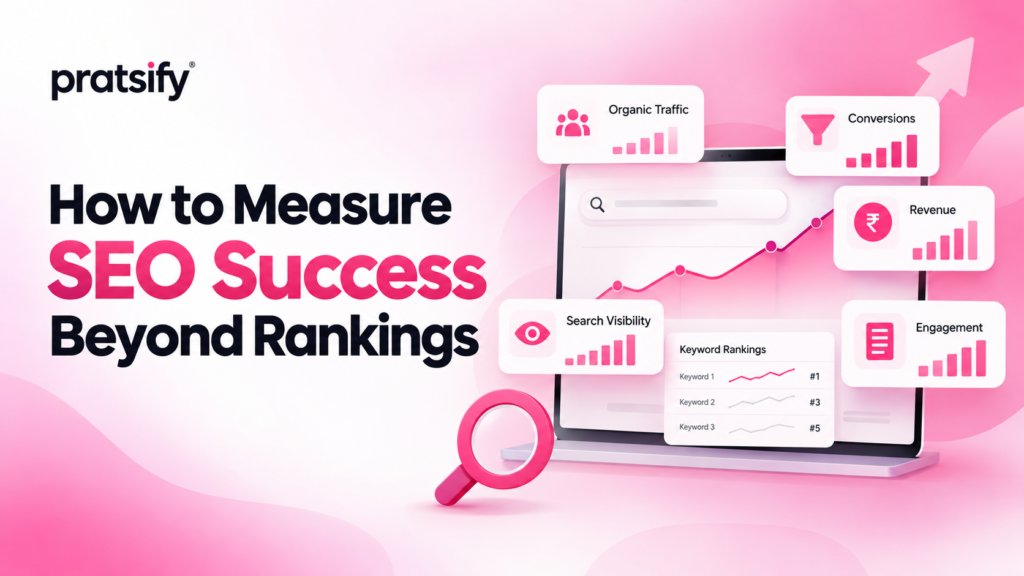
Keyword rankings are not enough to determine whether your SEO strategy is working. A website can rank on the first page of Google and still generate very few leads, sales, or meaningful business opportunities.
To understand the real impact of SEO, you need to look beyond search positions. Organic traffic, conversion rates, qualified leads, revenue, and customer acquisition provide a clearer picture of how search engine optimization contributes to business growth.
For example, ranking in the top three positions for a keyword with little buying intent may bring visitors without generating customers. Meanwhile, a service page ranking lower for a highly relevant commercial keyword could attract fewer visitors but generate more inquiries.
In this guide, we will explore how to measure SEO success using meaningful performance metrics, Google Analytics 4, Google Search Console, and a practical measurement framework.
Why Keyword Rankings Alone Are Not Enough to Measure SEO Success
Keyword rankings show where your website appears in search results for specific queries. They help you understand search visibility, but they do not tell you whether visitors are taking valuable actions after reaching your website.
There are several reasons why rankings alone cannot measure SEO performance.
Rankings do not directly indicate business growth.
Moving from position eight to position three is a positive SEO improvement. However, if the keyword does not attract your target audience, the ranking improvement may have little business value.
High rankings can attract irrelevant traffic.
A website might rank well for informational keywords that attract students, researchers, or people looking for free resources rather than potential customers.
Search results are not the same for everyone.
Google can display different results depending on location, device, search intent, and other contextual factors. A single ranking position does not represent every searcher’s experience.
Ranking improvements do not guarantee conversions.
Visitors may reach your website but leave without submitting a form, requesting a quote, purchasing a product, or contacting your business. This could indicate problems with your content, user experience, pricing, or calls to action.
Rankings represent only one part of SEO performance.
SEO involves attracting relevant visitors, meeting their search intent, building trust, and encouraging meaningful actions.
Rankings are useful diagnostic indicators, but they should not be treated as the primary measure of SEO success.
Key SEO Metrics That Matter Beyond Rankings
Measuring SEO performance requires a combination of traffic, engagement, conversion, and revenue metrics. These indicators help you understand not only how many people discover your website but also how valuable those visits are to your business.
Organic Traffic Growth
Organic traffic refers to visitors who reach your website through unpaid search engine results.
It is one of the most commonly monitored SEO metrics because it shows whether your website is attracting visitors from search engines.
However, increasing organic traffic is not automatically a sign of success. You also need to understand whether that traffic is relevant to your products, services, or business goals.
Here is what you should monitor:
- Organic sessions: The number of sessions originating from organic search.
- Organic users: The number of users who visit through organic search.
- Landing page traffic: Which pages attract the most organic visitors.
- Traffic growth: How organic traffic changes over time.
- Traffic quality: Whether visitors engage with your website and take meaningful actions.
For example, imagine your website receives 1,000 organic visitors in one month and 1,500 in the next month. That represents 50% traffic growth.
However, if most of the additional visitors leave without engaging or converting, you should investigate which keywords and landing pages are responsible for the increase.
Compare organic traffic month over month to monitor short-term changes. Year-over-year comparisons can help identify longer-term growth while accounting for seasonal differences.
Organic Conversions and Conversion Rate
Organic conversions measure the valuable actions visitors complete after arriving through unpaid search results.
These actions depend on your business model and website objectives.
For a service-based business, conversions might include:
- Contact form submissions.
- Quote requests.
- Phone calls.
- WhatsApp inquiries.
- Consultation bookings.
For an ecommerce website, conversions might include purchases, completed checkouts, or other important shopping actions.
Conversion rate helps you understand how effectively your website turns organic visitors into customers or potential customers.
You can calculate it using this formula:
Organic Conversion Rate = (Organic Conversions ÷ Organic Sessions) × 100
For example:
If your website receives 2,000 organic sessions and generates 40 conversions, your organic conversion rate is 2%.
This metric helps you evaluate whether your landing pages are encouraging visitors to take action.
If organic traffic increases but conversion rates decline, review your landing page content, search intent alignment, website navigation, and calls to action.
Qualified Leads From Organic Search
Generating leads is important, but not every inquiry represents a genuine business opportunity.
Qualified leads are prospects who match your target audience and have a reasonable interest in purchasing your product or service.
For example, a website development company might receive 50 organic inquiries in a month. However, only 15 may have a relevant project, suitable budget, and genuine purchasing intent.
In this situation, measuring all 50 inquiries as equally valuable would give an incomplete picture of SEO performance.
Track the following indicators:
- Total leads generated through organic search.
- Number of qualified organic leads.
- Lead-to-opportunity conversion rate.
- Number of organic leads converted into customers.
- Revenue generated from organic leads.
You can also connect website conversion tracking with your CRM to understand what happens after someone submits a contact form.
This makes it easier to identify which organic landing pages generate serious business inquiries rather than simply increasing form submissions.
Organic Revenue and Return on Investment
Revenue is one of the most meaningful indicators for businesses investing in SEO.
It helps connect organic search performance with actual financial outcomes.
For ecommerce websites, revenue attribution is relatively straightforward when purchase tracking is configured correctly in GA4.
For service businesses, the process may require additional tracking through a CRM or sales system because a website inquiry may convert into a customer days or weeks later.
Consider an example:
A website receives 20 leads from organic search in a month. Five of those leads become customers, generating ₹1,00,000 in revenue.
You can use this information to evaluate how much business organic search contributes.
SEO return on investment (ROI) can be calculated using:
SEO ROI = [(Revenue Attributed to SEO − SEO Investment) ÷ SEO Investment] × 100
For example, if organic search generates ₹1,00,000 in attributable revenue and your SEO investment is ₹20,000:
SEO ROI = [(₹1,00,000 − ₹20,000) ÷ ₹20,000] × 100
SEO ROI = 400%
This is a simplified calculation. For a more accurate assessment, consider delivery costs, sales expenses, attribution limitations, and the time required to convert organic leads.
You can also monitor customer acquisition cost (CAC) to understand how much it costs to acquire customers through your SEO investment.
Search Visibility and Impressions
Search visibility helps you understand how frequently your website appears in Google search results.
Google Search Console provides useful data for measuring this performance.
Important metrics include:
- Impressions: How often your website appears in search results.
- Clicks: How many times users click your website in search results.
- Click-through rate (CTR): The percentage of impressions that generate clicks.
- Average position: The average position of your website’s search results.
For example, a service page might receive 10,000 impressions but only 100 clicks.
Its CTR would be 1%.
This could indicate that your title tag and meta description need improvement, although the actual opportunity depends on the queries, search features, and positions involved.
You should also monitor branded and non-branded search visibility separately.
Branded searches include queries containing your business name. Non-branded searches include generic searches related to your products or services.
Growing non-branded visibility can indicate that your website is reaching people who were not already searching for your business.
Engagement and Landing Page Performance
Traffic and conversions are important, but understanding what visitors do after arriving on your website can reveal additional opportunities.
Google Analytics 4 provides engagement metrics that help evaluate how users interact with your content.
Some useful metrics include:
- Engaged sessions: Sessions that lasted longer than 10 seconds, included a key event, or had at least two page or screen views.
- Engagement rate: The percentage of sessions that were engaged sessions.
- Average engagement time: The average time your website was actively in focus for users.
- Landing page performance: How individual entry pages contribute to traffic and conversions.
For example, if a service page attracts 500 organic visitors but generates no inquiries, you should investigate whether the page addresses the visitor’s needs.
Check whether the service offering is clear, the content answers relevant questions, the page builds trust, and visitors can easily contact your business.
Remember that engagement metrics depend on the type of page. A visitor who quickly finds a phone number and calls your business may have a successful experience without spending several minutes on the website.
Do not treat longer engagement time as an automatic sign of better performance.
How to Measure SEO Performance Using Google Analytics 4
Google Analytics 4 (GA4) helps you understand how visitors interact with your website after arriving through organic search.
It provides information about traffic sources, user engagement, landing pages, and conversions.
Here is how to use GA4 to evaluate SEO performance.
Track Organic Search Traffic
Start by identifying how much website traffic comes from organic search.
In GA4:
- Open your GA4 property.
- Navigate to Reports.
- Open Acquisition and select Traffic acquisition.
- Find the Session default channel group dimension.
- Locate the Organic Search channel.
You can review organic sessions, engaged sessions, engagement rate, and key events.
Compare these metrics across different date ranges to understand whether your organic search performance is improving.
Measure Organic Conversions
To measure conversions, first identify the actions that matter to your business.
These might include purchases, lead form submissions, consultation bookings, or other important interactions.
Configure the appropriate events in GA4 and mark relevant events as key events.
Once tracking is configured, you can evaluate how organic search contributes to those actions.
For example, if your website receives 1,000 organic sessions and generates 25 form submissions, you can use this information to calculate your organic lead conversion rate.
Make sure conversion events are configured correctly and do not count duplicate submissions as separate leads.
Analyze Landing Page Performance
Landing pages are the first pages visitors reach when they enter your website.
They are important because different pages attract visitors with different search intents.
In GA4:
- Open the Reports section.
- Navigate to Engagement.
- Select Landing page.
- Review organic traffic and engagement for individual pages using an organic search segment or comparison.
Look for pages that:
- Generate significant organic traffic.
- Have strong engagement.
- Generate valuable key events.
- Attract traffic but produce very few conversions.
This analysis helps you identify which pages deserve further optimization.
Compare Organic Search With Other Traffic Channels
SEO should not be evaluated in isolation.
GA4 allows you to compare organic search with channels such as paid search, direct traffic, referral traffic, and social media.
For example, organic search might generate fewer visitors than paid advertising but deliver a higher conversion rate.
This comparison can help you understand the contribution of each acquisition channel.
However, make sure you compare similar audiences, conversion definitions, and reporting periods.
Build an SEO Performance Report
A useful SEO report should connect website traffic with business outcomes.
Include the following metrics:
| Metric | What it tells you |
|---|---|
| Organic sessions | Traffic generated through organic search |
| Engaged sessions | Meaningful website engagement |
| Engagement rate | Quality of organic sessions |
| Key events | Important actions completed |
| Landing page conversions | Pages generating valuable actions |
| Organic revenue | Financial contribution from organic search |
Review these metrics monthly and compare them with previous periods.
A good SEO report should explain what changed, why it matters, and what actions should follow.
How to Use Google Search Console to Measure SEO Success
Google Search Console (GSC) provides direct insights into how your website performs in Google Search.
Unlike GA4, which focuses on website visits and user behavior, Search Console helps you understand what happens before visitors reach your website.
Monitor Total Clicks and Impressions
Open Google Search Console and select the Performance report.
You can monitor total clicks and impressions over a selected date range.
Clicks show how many times users visited your website through Google search results.
Impressions show how frequently your website appeared in those results.
An increase in impressions may indicate growing search visibility, even before organic clicks increase.
Analyze Organic Click-Through Rate
Click-through rate (CTR) measures the percentage of search impressions that generate clicks.
The formula is:
CTR = (Total Clicks ÷ Total Impressions) × 100
For example, if a page receives 500 clicks from 10,000 impressions, its CTR is 5%.
If a page receives significant impressions but has a low CTR, investigate:
- Whether the title accurately reflects search intent.
- Whether the meta description communicates the page’s value.
- Whether the page is appearing for relevant queries.
- Whether search features are affecting organic clicks.
Do not evaluate CTR without considering average position and query type. A page ranking lower will naturally have different CTR expectations from one ranking at the top.
Track Search Query Performance
The Queries report shows the search terms for which your website receives impressions and clicks.
Use it to identify:
- Queries generating the most organic clicks.
- Keywords gaining impressions.
- Queries with improving or declining performance.
- Relevant search terms you have not fully addressed in your content.
You can also identify informational and commercial queries to understand whether your website attracts visitors at different stages of the buying journey.
Identify Pages With Growing Search Visibility
The Pages report helps you understand which URLs receive impressions and clicks.
Compare performance over different periods to find pages gaining search visibility.
For example, a service page might experience increasing impressions but relatively slow click growth.
This could be an opportunity to improve its title, description, content relevance, or overall search intent alignment.
Find Opportunities to Improve Existing Content
Search Console can help identify pages that already have search visibility but are not generating enough clicks.
Look for pages with:
- High impressions and low CTR.
- Relevant queries with growing impressions.
- Declining clicks over time.
- Multiple queries related to topics that need better coverage.
Use these insights to update existing content, improve internal linking, clarify search intent, and strengthen page titles.
How GA4 and Google Search Console work together
These tools provide different but complementary information.
| Google Search Console | Google Analytics 4 |
|---|---|
| Search impressions | Website sessions |
| Search clicks | User engagement |
| Search queries | Landing page performance |
| Average search position | Key events |
| Search CTR | Conversion behavior |
Using both tools gives you a more complete understanding of SEO performance, from search visibility to actions taken on your website.
How to Measure SEO Success at Different Stages
SEO performance should be evaluated according to the maturity of your campaign.
A newly launched website and an established website will not have the same priorities.
The metrics you monitor should reflect the work completed and the results you expect at each stage.
| SEO stage | Important metrics |
|---|---|
| Initial SEO work | Indexing, technical issues, impressions |
| Early growth | Impressions, clicks, organic traffic |
| Visibility growth | Non-branded clicks, landing page traffic |
| Lead generation | Qualified leads, conversion rate |
| Business growth | Revenue, ROI, customer acquisition |
For example, a new website may initially focus on getting important pages indexed and improving search visibility.
As its organic presence grows, attention can shift toward relevant traffic, qualified leads, and conversions.
For an established website, revenue contribution, customer acquisition, and SEO ROI may be more important performance indicators.
Avoid judging a campaign using business outcomes alone before enough relevant search visibility and traffic have developed.
How to Create an SEO Measurement Framework
A structured SEO measurement framework helps you connect optimization activities with measurable business goals.
Instead of monitoring dozens of unrelated metrics, focus on the indicators that demonstrate whether your strategy is delivering results.
Define Your Business Goals
Start by identifying what you want SEO to achieve.
Different businesses have different objectives.
For example:
- A local service business may want more phone calls and quote requests.
- An ecommerce store may want more organic purchases and revenue.
- A SaaS company may want more product sign-ups and qualified demos.
- A professional services company may want more consultation bookings.
Your business goals should determine which SEO metrics you prioritize.
Select SEO KPIs That Match Those Goals
Once you define your goals, choose the key performance indicators (KPIs) that help measure progress.
For a lead-generation website, useful KPIs might include:
- Organic sessions.
- Qualified organic leads.
- Lead conversion rate.
- Cost per qualified lead.
- Organic lead-to-customer conversion rate.
For ecommerce websites, prioritize organic transactions, revenue, conversion rate, and average order value.
Avoid treating every available GA4 or Search Console metric as an equally important KPI.
Set a Performance Baseline
Before implementing major SEO improvements, record your existing website performance.
Your baseline should include:
- Current organic traffic.
- Search impressions and clicks.
- Important landing page performance.
- Existing conversion rates.
- Qualified leads and organic revenue, where available.
This gives you a reference point for measuring future improvements.
Without a baseline, it becomes difficult to determine whether your SEO strategy is producing meaningful progress.
Track Metrics Monthly
Create a monthly SEO report that compares current performance with previous periods.
Monitor changes in organic traffic, search visibility, conversions, and lead quality.
For example, if organic traffic increases by 20% but qualified leads remain unchanged, investigate whether the additional visitors match your target audience.
Monthly reporting helps you identify performance changes and prioritize the next optimization activities.
Connect SEO Data With Business Results
Website analytics alone cannot always explain the full customer journey.
A visitor may discover your website through Google, submit an inquiry, speak with your sales team, and become a customer several weeks later.
Connecting GA4 with CRM data helps you understand this journey.
Track lead sources, lead status, sales opportunities, and customer revenue wherever possible.
This makes it easier to evaluate the business value of organic search.
Review Performance and Adjust Your Strategy
SEO measurement should lead to action.
Use your performance data to identify what is working and where improvements are needed.
For example:
- If impressions increase but clicks remain low, review search snippets and query relevance.
- If traffic increases but conversions remain low, improve landing page messaging and conversion paths.
- If leads increase but lead quality declines, review keyword targeting and search intent.
- If organic revenue grows, identify which pages and topics contribute most to that growth.
Your SEO strategy should evolve based on measurable performance rather than assumptions.
Need help understanding what your SEO data actually means? Pratsify helps businesses improve search visibility, attract relevant organic traffic, and connect SEO performance with meaningful business outcomes. Explore our SEO services to build a measurement-focused SEO strategy.
Common SEO Measurement Mistakes to Avoid
Even when businesses track SEO metrics regularly, certain mistakes can lead to misleading conclusions.
Here are some common problems to avoid.
Focusing only on keyword positions: Ranking improvements are useful, but they do not necessarily generate leads or revenue.
Treating all organic traffic as valuable: More visitors do not always mean better business performance. Focus on relevant traffic that matches your target audience.
Ignoring conversion tracking: Without properly configured conversion events, you cannot accurately evaluate how organic visitors contribute to business goals.
Measuring traffic without considering search intent: A page may attract thousands of informational visitors who have little interest in purchasing your services.
Expecting immediate SEO results: SEO performance develops over time. Evaluate progress using realistic timeframes and campaign objectives.
Ignoring branded versus non-branded traffic: Growth in branded searches does not necessarily mean your website is attracting more new audiences through generic searches.
Reporting vanity metrics without business context: Large impression counts and traffic numbers can look impressive but may not reflect actual business growth.
Failing to track performance consistently: Inconsistent reporting makes it difficult to identify trends, seasonal changes, and the impact of optimization activities.
How Often Should You Measure SEO Performance?
SEO performance should be monitored regularly, but not every metric requires daily attention.
A practical reporting schedule helps you identify technical problems, evaluate campaign progress, and make informed decisions.
Weekly monitoring
Check for:
- Major organic traffic fluctuations.
- Indexing and crawling issues.
- Unexpected technical errors.
- Significant changes in important landing pages.
Monthly performance reviews
Evaluate:
- Organic traffic growth.
- Search impressions and clicks.
- Conversion rates.
- Qualified organic leads.
- Landing page performance.
- Changes in important search queries.
Quarterly SEO reviews
Evaluate:
- Overall SEO strategy performance.
- Organic revenue contribution.
- SEO ROI.
- Customer acquisition trends.
- Content performance.
- Opportunities for new keyword targeting.
Year-over-year comparisons are also valuable because they help account for seasonal demand and recurring business patterns.
The goal is not to produce more reports. It is to use the available data to make better SEO decisions.
Final Words: Measure SEO by Business Impact, Not Just Rankings
Keyword rankings are useful for understanding search visibility, but they do not tell the complete story of SEO performance.
To measure SEO success accurately, businesses should monitor organic traffic, engagement, conversions, qualified leads, and revenue.
Google Analytics 4 helps you understand what visitors do after reaching your website, while Google Search Console shows how your website performs in Google Search.
When you combine these insights with business data, you can understand which SEO activities contribute to actual growth.
The most effective SEO strategy is not simply about getting more keywords to rank. It is about attracting the right audience, creating useful website experiences, and turning organic visibility into measurable business results.
Turn SEO Traffic Into Business Growth
Higher rankings are valuable, but generating qualified leads and revenue is what really matters. Pratsify helps businesses improve search visibility, attract relevant organic traffic, and turn website visitors into customers through practical SEO strategies.
Want to make your SEO investment count?
Frequently Asked Questions
You can measure SEO success through organic traffic, search impressions, click-through rates, conversion rates, qualified leads, revenue, and customer acquisition. These metrics help you understand whether your website attracts relevant visitors and contributes to business goals.
The most important SEO KPIs depend on business objectives. Common indicators include organic sessions, qualified leads, organic conversion rate, organic revenue, customer acquisition cost, and SEO ROI.
For lead-generation businesses, qualified leads and lead conversion rates are particularly important. For ecommerce websites, organic transactions and revenue are key indicators.
Organic traffic is a useful indicator because it shows how many visitors reach your website through unpaid search results. However, traffic alone does not guarantee SEO success. You should also evaluate visitor relevance, engagement, conversions, and revenue.
SEO timelines vary depending on website history, competition, technical health, content quality, and the resources invested. Some improvements in indexing and search visibility may appear relatively quickly, while meaningful traffic growth and business results can take several months.
Evaluate SEO progress consistently instead of relying on a single reporting period.
Google Analytics 4 measures website traffic, engagement, landing page performance, and conversions. Google Search Console provides information about search impressions, clicks, CTR, queries, and average search position.
Using both tools helps you understand how people discover your website and what they do after visiting it.
SEO metrics are individual measurements used to evaluate website and search performance. Examples include organic sessions, impressions, clicks, and engagement rate.
SEO KPIs are the specific metrics selected to measure progress toward business objectives. For example, a lead-generation company might prioritize qualified organic leads and lead conversion rate as its primary KPIs.
SEO ROI measures the financial return generated through SEO compared with the investment made.
The formula is:
SEO ROI = [(SEO-attributed Revenue − SEO Investment) ÷ SEO Investment] × 100
For example, if SEO generates ₹2,00,000 in attributable revenue and costs ₹50,000, the simplified SEO ROI is 300%.
For more accurate calculations, account for relevant operating expenses and use a consistent revenue attribution method.