I get asked this question almost every week now. A client will message me and say something like, “Pratham, why does ChatGPT mention my competitor and not me?” And honestly, it’s one of my favorite questions to answer because most people are still thinking about this the wrong way.
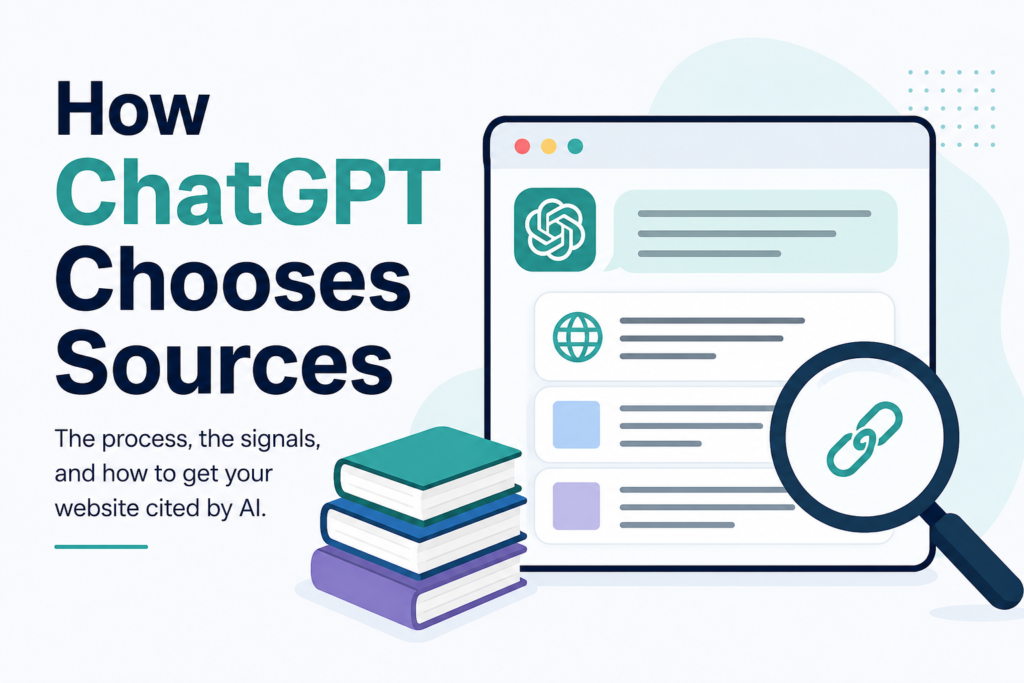
ChatGPT does not rank websites the way Google does. There’s no position one, position two, position three. It picks information based on how relevant it is, how trustworthy the source feels, whether the facts check out, how well the content is structured, and whether it actually answers what the user asked. I’ve watched this play out across dozens of client sites over the past year, including one domain with a Domain Rating of just 2.6 that ended up getting cited 187 times by AI systems within a few months. That number alone should tell you that authority in the AI search world doesn’t work the same way it worked in the old Google world.
So let’s break down exactly how this works, because once you understand the mechanics, you can actually do something about it.
How Does ChatGPT Find Information?
ChatGPT blends what it already learned during training with live web results when browsing is turned on, and it uses both to build an answer that feels complete and trustworthy.
Here’s what’s actually happening behind the scenes. When someone asks ChatGPT a question, it isn’t just pulling one article and repeating it back. It’s pulling from its pretrained knowledge first, which is everything it learned before its cutoff date. Then, if web search is enabled, it goes out and retrieves fresh information from the internet.
From there, it compares what it finds across multiple sources. It’s not going to trust a single blog post blindly. It’s checking whether different sources agree with each other. If five sites say one thing and one site says something completely different, that outlier source is probably getting ignored.
Then it does something I think most website owners don’t realize happens: it checks for confidence. If the information is vague, contradictory, or poorly explained, the model is less likely to lean on it heavily in the final answer. And finally, it picks whichever explanation is the clearest and most useful for the person asking.
Think of it like this flow:
User asks a question, the model retrieves possible sources, it compares them against each other, it verifies the facts line up, and only then does it generate the final answer.
If your content is confusing, contradictory to itself, or buried under fluff, it’s simply harder for the model to use you as a reliable input, even if your information is technically correct.
Does ChatGPT Use Google?
No. ChatGPT doesn’t run on Google’s ranking algorithm. When it does browse the web, it pulls from available search providers and then evaluates what it finds on its own terms, not Google’s.
This is something I explain to almost every new client because it changes how they should think about their entire content strategy. Google ranks based on links pointing to a page, keyword usage, and position on a results page. ChatGPT is not playing that game. It’s trying to construct an answer, not a list of links.
Here’s a simple way I break down the difference for clients who are used to traditional SEO thinking.
Google works around links. ChatGPT works around answers.
Google cares about keywords. ChatGPT cares about context.
Google leans on backlinks. ChatGPT leans on authority combined with clarity.
Google is obsessed with position. ChatGPT is obsessed with information quality.
I’ve had clients who ranked on page one of Google for years but were completely invisible in AI answers, simply because their content was written for search engine crawlers instead of for actual human questions. That gap is where most of my GEO work starts.
What Makes ChatGPT Choose One Website Over Another?
AI systems lean toward sites that show real authority, are structured cleanly, stick to the facts, and directly answer full user questions instead of dancing around them.
This is where things get interesting, and honestly this is where most of my day to day work happens. Let me walk you through what I’ve seen consistently move the needle.
Clear answers matter more than clever writing. If someone asks “what is the best PLC for a small manufacturing plant,” and your article buries the answer three paragraphs deep under a story about your company history, you’re making it harder for the model to extract value from your page.
Original research is a massive differentiator. I say this constantly to my clients. If you’re just repeating what ten other sites already said, why would the model choose you over the other nine? When I worked on content for AutomatexLab, we made sure every piece had something original in it, whether that was a specific case example, a real technical breakdown, or an insight pulled from actual field experience rather than generic industry summaries.
EEAT signals genuinely matter here, and I don’t say that just because Google trained us to care about it. Experience, expertise, authoritativeness, and trust are exactly what a language model is trying to detect when it decides whether to lean on your content. An article written by someone with a name, a background, and a clear point of view reads very differently to these systems than an anonymous, generic post.
Updated information counts too. Stale content, especially in fast moving industries like industrial automation or AI tools, tends to get passed over in favor of fresher explanations.
Structured headings, proper schema markup, clear entity relationships, expert authorship, internal topic clusters, and consistency across your pages all stack together to build a picture of a trustworthy, organized source. None of these things alone will make or break your visibility, but together they compound.
What Ranking Signals Does AI Seem to Prefer?
Quick answer: OpenAI hasn’t published an official ranking formula, but based on what I’ve tested and observed across client sites, content quality, topical authority, semantic relevance, and completeness consistently show up as the strongest patterns.
I want to be honest with you here. Nobody outside these companies has the exact algorithm. What I’m sharing comes from pattern recognition across real client work, tracking which pages get cited and which don’t, and adjusting based on results.
Semantic relevance is huge. The model isn’t just matching keywords anymore, it’s understanding meaning and context around a topic.
Context depth matters just as much. A 300 word answer rarely beats a 2,000 word answer that actually explains the topic from multiple angles.
Topic authority builds over time. If your site consistently publishes strong content around one subject area, the model starts to associate your domain with that topic.
Entity coverage is something a lot of people skip. This means clearly naming the tools, brands, technologies, or concepts related to your topic instead of writing vaguely around them.
Citations, expert references, and updated pages all add credibility. FAQs, tables, lists, statistics, and original examples give the model easy to extract, structured pieces of information it can pull directly into an answer.
Why Isn’t Traditional SEO Enough Anymore?
Quick answer: Traditional SEO is built around rankings, backlinks, and keywords, while AI optimization is built around answering real questions with complete context and trustworthy, connected information.
I still do traditional SEO for clients, don’t get me wrong. It’s not dead. But relying on it alone in 2026 is like showing up to a car race on a bicycle. It might get you somewhere, but not fast enough.
| Traditional SEO | AI Optimization (GEO/AEO) |
|---|---|
| Focuses on rankings | Focuses on directly answering questions |
| Built around backlinks | Built around complete context |
| Keyword driven | Entity and relationship driven |
| Optimizes for crawlers | Optimizes for trusted, structured information |
The businesses I work with who are seeing the strongest results right now are the ones blending both approaches instead of picking one over the other.
How Can You Increase Your Chances of Being Cited by ChatGPT?
This is the part everyone actually wants, so let’s get practical.
Answer questions directly, right at the top of your content. Don’t make people scroll to find the point.
Publish original research whenever you can. Even something small like your own client data or a unique case study goes a long way.
Add real expert insights, not generic advice you could find anywhere. This is exactly why I write from my own consulting experience instead of paraphrasing what other agencies say.
Create topical clusters instead of isolated posts. When I built out the AutomatexLab blog library, we didn’t just write one PLC article and stop. We covered Allen-Bradley, Siemens, Mitsubishi, Omron, and Schneider Electric systems, tied together through internal linking, so the site built genuine topical depth around industrial automation.
Build entity authority by clearly associating your brand with specific topics over time.
Add statistics wherever they’re relevant. Numbers give AI systems something concrete to pull from.
Update your content regularly. Stale pages lose trust over time, both with search engines and AI models.
Improve your technical SEO fundamentals. Site speed, mobile experience, and clean site architecture still matter here.
Add schema markup, especially FAQ schema and Article schema, so machines can parse your content structure easily.
Build brand mentions across the web, even without a direct link. Mentions alone can build entity recognition.
Earn quality backlinks where you can, since they still contribute to overall authority signals.
Improve readability. Short paragraphs, simple language, and clear formatting help both humans and AI systems understand your content faster.
What Are the Common Reasons AI Doesn’t Reference Your Website?
I’ve audited enough sites now to see the same problems repeating over and over.
Thin content that doesn’t go deep enough on the topic. Duplicate articles that add nothing new to what already exists online. Obvious AI generated fluff with no real expertise behind it. No demonstrated topical authority across your site. Weak internal linking that leaves your content isolated instead of connected. Outdated information that no longer reflects reality. Missing author information, which quietly kills trust signals. Poor page structure that makes content hard to scan. And a slow website, which still impacts crawlability and user experience even in an AI first world.
If even a few of these apply to your site, that’s usually enough to explain why you’re not showing up in AI generated answers yet.
A Real Example Worth Looking At
Let me give you a simple comparison I use with clients all the time.
Website A publishes a 500 word article. It’s generic, has no listed author, and offers no real examples.
Website B publishes a 2,500 word guide. It includes original research, a solid FAQ section, real statistics, a named expert author, and internal links connecting it to related content on the site.
Which one do you think a language model is more likely to lean on when building an answer? Website B wins almost every time, and it’s not close. This is exactly the gap I try to close for clients who are used to writing thin content because “that’s what used to work” for basic SEO years ago.
What Does the Future of AI Search Look Like?
This space is moving fast, and I say that as someone who’s watching it shift in real time through client results.
GEO and AEO are becoming standard parts of any serious content strategy, not niche add ons anymore. AI citations are turning into a real trust signal businesses actively chase. Conversational search is replacing the old keyword typing habit. Agentic AI is starting to take actions on behalf of users, not just answer questions. Multi source answers are becoming the norm instead of single link results. Brand authority is turning into a measurable asset in AI visibility. And knowledge graphs are quietly becoming the backbone connecting entities, brands, and topics together across the web.
If you’re building a content strategy today without thinking about any of this, you’re building for a search landscape that’s already changing underneath you.
How Pratsify Helps Businesses Become AI Visible
This is exactly the work I do every day through Pratsify.
I don’t just do SEO in the traditional sense anymore. My focus has shifted toward helping businesses actually show up inside AI generated answers, which is a completely different discipline than chasing Google rankings alone.
Through Pratsify, I work with clients on Generative Engine Optimization to help their content get pulled into AI answers, Answer Engine Optimization to structure content around real user questions, and full AI citation strategy built around what I’ve personally tested across multiple industries.
I help businesses build topical authority development plans instead of scattered, random blog posts. I build out content clustering strategies so every piece of content supports the others around it. I work on entity optimization so AI systems clearly understand what your brand actually does. I implement structured data so machines can parse your content correctly. I handle technical SEO specifically aimed at AI discovery, not just traditional crawlers. I create AI ready content from the ground up rather than retrofitting old blog posts. And I run ongoing AI visibility monitoring so you actually know whether your strategy is working instead of guessing.
If you’re tired of watching competitors get mentioned in ChatGPT answers while your business stays invisible, that’s a fixable problem, and it’s one I work on with clients every single week. Reach out and let’s figure out what your site is missing.
FAQs
Does ChatGPT use backlinks?
Not in the traditional Google sense. Backlinks can still contribute to overall brand authority signals, but they’re not a direct ranking factor the way they are in classic SEO.
Can ChatGPT cite my website?
Yes, when web browsing is enabled and your content matches the relevance, clarity, and trust signals the model is looking for.
Does ChatGPT read schema markup?
It can benefit indirectly, since schema helps structure your content in a way that’s easier for both search engines and AI systems to parse and understand.
Is AI optimization different from SEO?
Yes, though they overlap. Traditional SEO focuses on rankings and keywords, while AI optimization focuses on directly answering questions with complete, trustworthy context.
Does ChatGPT prefer trusted websites?
Generally yes. Sites with clear authorship, consistent topical authority, and factual accuracy tend to get referenced more often.
How often does ChatGPT update its knowledge?
This depends on the model version and whether live web browsing is enabled. Pretrained knowledge has a cutoff date, but browsing pulls in current information.
How can I improve AI visibility?
Focus on clear, direct answers, original insights, strong topical authority, proper structure, and consistent updates across your content.
Can small websites appear in ChatGPT answers?
Absolutely. I’ve seen this firsthand with low authority domains getting cited well ahead of much bigger, more established competitors, simply because the content was structured and written the right way.
What is the difference between GEO and SEO?
SEO is built around ranking on search engines like Google. GEO is built around getting referenced and cited inside AI generated answers across platforms like ChatGPT, Perplexity, and Gemini.
Does ChatGPT always cite sources?
No. It depends on the query type, whether web browsing is active, and whether the model determines that citing a specific source adds value to the answer.