Shopify Plus vs Magento 2: Which Scales Better for a $1M Store?

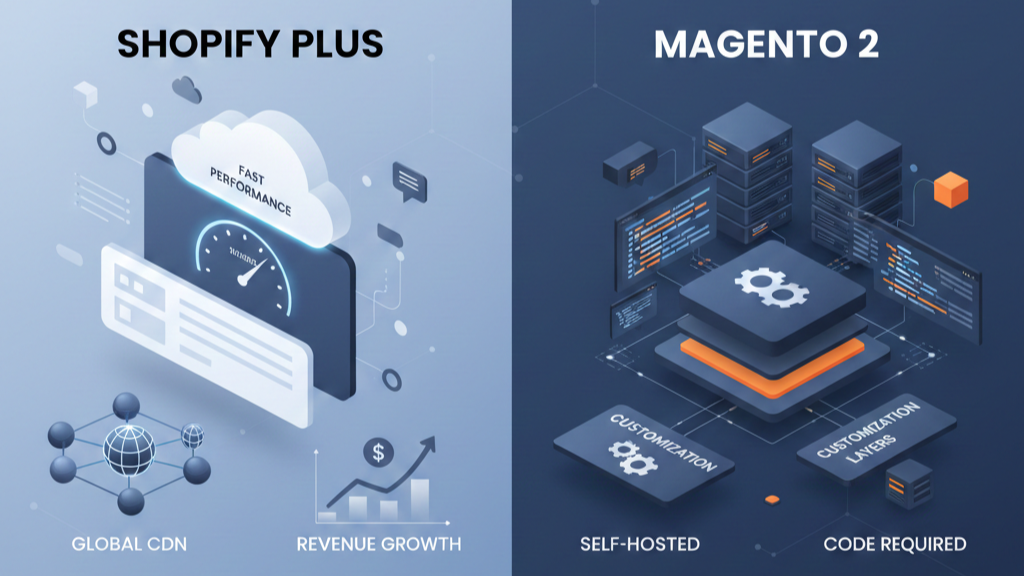
If you’ve crossed $1M in annual revenue and your platform is now a growth limiter, not an enabler, you’re facing a classic scaling decision: Shopify Plus or Magento 2? I’ve audited and optimized multi-million-dollar stores on both platforms, and I’ve seen how infrastructure, tech debt, and operational costs silently throttle growth. The right platform doesn’t just handle traffic spikes or global expansion it empowers you to innovate, integrate with critical systems, and optimize conversions without constant firefighting. In this head-to-head, I evaluate real scaling factors: SaaS architecture, inventory management, API integration, total cost of ownership, performance, and conversion optimization. I cut through buzzwords so you can decide which platform truly accelerates a $1M store toward $5M and beyond.
In Short:
For most $1M e-commerce stores targeting predictable growth, Shopify Plus scales better because its SaaS architecture manages infrastructure, security, and performance while you focus on marketing and conversion rate optimization. Magento 2 can scale deeply, but it requires significant engineering resources, custom hosting, and ongoing maintenance, which often outweighs the benefits for typical business owners.
Quick Comparison Table
| Scaling Factor | Shopify Plus | Magento 2 |
|---|---|---|
| Hosting & Infrastructure | Managed SaaS | Self-managed |
| Performance at Scale | Consistent | Variable |
| Inventory Management | Built-in, strong | Highly customizable |
| API Integration | Powerful + predictable | Deep but complex |
| Total Cost of Ownership | Predictable | Often higher long-term |
| Dev Ops Overhead | Minimal | Significant |
| Conversion Optimization | Built-in tools | Plugin/custom dependent |
| Custom Logic | Limited to APIs/apps | Unlimited |
What “Scaling” Actually Means for a $1M Store
When I talk about scaling here, I mean more than just handling a traffic bump. I mean:
- Predictable performance under peak load
- Seamless inventory management across channels and regions
- API ecosystems that connect ERP, CRM, OMS, and fulfillment
- Flexibility to innovate without downtime
- Conversion rate optimization without breaking the platform
- Lower operational drag as the business grows
You don’t scale by accident. You scale with systems that keep your store fast, secure, and extensible.
Shopify Plus: SaaS Architecture Built for Predictable Scaling
Managed Infrastructure and Performance
Shopify Plus is fundamentally a Software as a Service (SaaS) product. This matters.
With Shopify Plus:
- You never manage servers, scaling policies, or patching.
- Global content delivery is baked in.
- PCI compliance and security updates are automatic.
- Traffic spikes don’t require ops scripting.
For a $1M store, this means your infrastructure adjusts automatically to traffic surges from campaigns, influencer pushes, or holiday spikes without a DevOps specialist.
Unlike self-hosted platforms, you don’t pay engineers just to keep the lights on. You pay them to improve the shopping experience because the platform handles scaling.
Built-In Performance and Conversion Optimization
Performance isn’t a feature you can tack on later. It’s a prerequisite for sustained scale.
Shopify Plus provides:
- CDN across geographies
- Optimized asset delivery
- Mobile performance enhancements
- Fast, compliant checkout flow
All of these contribute to higher conversion rates out of the box.
You can also leverage built-in features such as abandoned checkout recovery, dynamic checkout buttons, and streamlined payment gateways that boost revenue without heavy plugin stacks.
Inventory Management for Multi-Channel Growth
Shopify Plus supports:
- Multi-location inventory tracking
- Real-time stock sync
- OMS integrations via robust APIs
If your growth plan includes selling on marketplaces, retail POS, and direct channels, Shopify’s systems scale without you having to build custom solutions.
API Integration and Headless Flexibility
Shopify Plus offers both REST and GraphQL APIs.
GraphQL, in particular, lets you:
- Retrieve only the data you need
- Build headless storefronts
- Connect complex ERPs
You get integration power without the inconsistency that plagues many self-hosted API layers.
Magento 2: The Customizable Powerhouse
Magento 2 (Community Edition or Adobe Commerce) is an open-source, self-hosted platform. That sounds great for customization and it is if you have the engineering horsepower.
Deep Inventory Management and Business Logic
Magento’s MSI (Multi-Source Inventory) is extremely robust:
- Multiple warehouses per SKU
- Complex allocation rules
- Region-specific stock policies
If your business model requires logistical complexity not supported by most SaaS inventory systems, Magento gives you the tools.
But here’s the catch: these tools aren’t plug-and-play. You must architect and tune every layer.
Hosting, Ops, and Performance Engineering
Magento doesn’t come with hosting.
A scalable Magento setup requires:
- Dedicated cloud instances (AWS, GCP, Azure)
- Load balancers
- Database clustering
- Caching strategies (Redis, Varnish)
- DevOps pipelines
This Ops overhead is the reason Magento gets a reputation for scaling only if you invest heavily in engineering.
Every traffic surge becomes a test of your infrastructure, not just a business opportunity.
API Integration and Custom Systems
Magento’s API is powerful and deep, but inconsistent.
You can expose nearly every part of the system via API, but:
- Version discrepancies require maintenance
- Custom endpoints often need bespoke development
- Real-time ERP syncing is engineer-dependent
This level of flexibility is unmatched but not free.
Cost Comparison: Predictable Platform vs Variable Engineering
Shopify Plus Costs
Shopify Plus pricing is clear:
- Predictable monthly fee
- Hosting, scaling, and security included
- Your primary costs become:
- Apps
- Themes
- Integrations
This predictability lets you forecast budget for marketing, ads, and growth initiatives.
You don’t schedule “infrastructure upgrades” before Black Friday. Shopify handles it.
Magento 2 Costs
Magento’s base software is free (Community Edition). But scalable deployments cost real money:
- Hosting and scaling infrastructure
- Security audits and updates
- DevOps engineers
- Performance tuning
- Module licensing (if using third-party extensions)
- QA each time you upgrade
Upfront cost might look cheaper. But as you scale revenue, your Total Cost of Ownership (TCO) often surpasses Shopify Plus for a typical e-commerce business.
You pay in engineering hours, not subscription fees.
Real Scaling Signals I See in Practice
Shopify Plus Stores
I’ve seen $1M stores scale to $10M without rewriting platform code.
They benefit from:
- Managed infrastructure that adjusts automatically
- Conversion tools that remain stable under peak load
- Easy inventory extensions
- API integrations that don’t fail under load
- Faster time to market for campaigns
Plus stores rarely collapse under traffic spikes unless the frontend is poorly built not the platform itself.
Magento 2 Stores
Magento stores can be beasts…but only with engineers riding them.
I’ve audited Magento setups where:
- Simple upgrades broke APIs
- Traffic spikes crumbled performance
- Inventory sync lagged due to server misconfiguration
- Ops costs exceeded marketing budgets
This isn’t the fault of Magento’s code it’s the maintenance burden of self-hosting.
API Ecosystem: Speed of Integration Matters
Shopify Plus APIs are consistent across releases and backed by documentation and tooling.
Magento’s API is deep, but version differences and custom extensions can introduce inconsistencies.
If your scaling strategy depends on real-time ERP, OMS, CRM, and fulfillment pipelines, the easier, predictable API layer wins every time.
You shouldn’t spend your engineering budget fixing platform inconsistencies you should spend it on growth features.
Inventory Management: Built-In vs Hand-Crafted
Shopify Plus:
- Ready to go
- Scales with multi-location logic
- Syncs across channels
Magento 2:
- Extremely customizable
- Requires architecture and maintenance
- Business logic lives in custom code
If your model is standard multi-channel retail, Shopify Plus scales more predictably.
If your model demands bespoke warehouse logic, Magento is powerful but costly.
Conversion Optimization and UX
Shopify Plus includes:
- Fast checkout experiences
- Abandoned cart recovery
- Mobile-first performance
- App ecosystem for upsells and A/B testing
Magento can match all of these but requires:
- Plugins
- Custom engineering
- QA after each platform upgrade
If your scaling plan includes improving conversion rate without breaking everything with every update, Shopify Plus is easier to maintain.
Headless Commerce: Both Support It
Both platforms offer headless options:
- Shopify Plus: Storefront API
- Magento 2: API + GraphQL
Headless setups can improve performance and customer experience.
But on Shopify Plus, you still leverage managed backend scaling while innovating on the frontend.
On Magento, you must manage both backend and frontend performance.
That means your engineering team carries twice the responsibility.
Security, Compliance, and Risk Management
Shopify Plus handles:
- PCI compliance
- Ongoing security patches
- DDoS protection
- Fraud detection tools
Magento requires you to:
- Update security patches
- Harden servers
- Monitor threats
- Maintain compliance
For a fast-growing store, security shouldn’t be another line item on your task list.
On Shopify Plus, it’s built-in.
When Magento 2 Does Scale Better
Magento 2 scales best when:
- You have dedicated engineers
- You have unique business logic
- You require custom transactional workflows
- Your product and checkout processes are non-standard
In these cases, Magento’s open nature rewards investment but make no mistake: that investment is ongoing.
Most $1M stores don’t need this depth yet. They need growth velocity.
Final Verdict: Which Scales Better
Shopify Plus scales better for most $1M e-commerce stores.
My conclusion is based on real operational, performance, and integration signals:
- Predictable infrastructure that auto-scales
- Strong built-in inventory and API tools
- Faster conversion optimization
- Lower dev and ops overhead
- Better cost predictability
- Easier API integration and headless capabilities
Magento 2 is powerful, but its openness comes with significant engineering obligation.
If your roadmap hinges on efficiency, predictable TCO, and continuous iteration without constant platform maintenance, Shopify Plus wins.
Magento 2 wins when your business must do things no SaaS platform can support and you can afford a dedicated tech team to build and maintain it.
FAQs
Does Shopify Plus support headless commerce?
Yes. Shopify Plus’s Storefront API lets you build custom headless frontends with modern frameworks, staying scalable without backend ops overhead.
Is Magento 2 free?
The Community Edition is free software, but scaling it effectively requires paid hosting, engineering, and maintenance.
Which is better for international stores?
Shopify Plus includes multi-currency, region-based inventory management, and global CDN. Magento can handle these too, but you must architect and maintain them.
Can I migrate from Magento to Shopify Plus later?
Yes. Many stores do this to escape tech debt and focus on growth, particularly if ops costs balloon on self-hosted setups.
Which platform has better inventory management?
Magento offers deeper configurability, but Shopify Plus offers reliable, scalable inventory tools with fewer technical hurdles.



[…] migrate from Magento to Shopify, back up your Magento store completely, export products, customers, and orders, set up your Shopify […]