Native vs Cross-Platform Mobile App Development: Which Should You Choose?

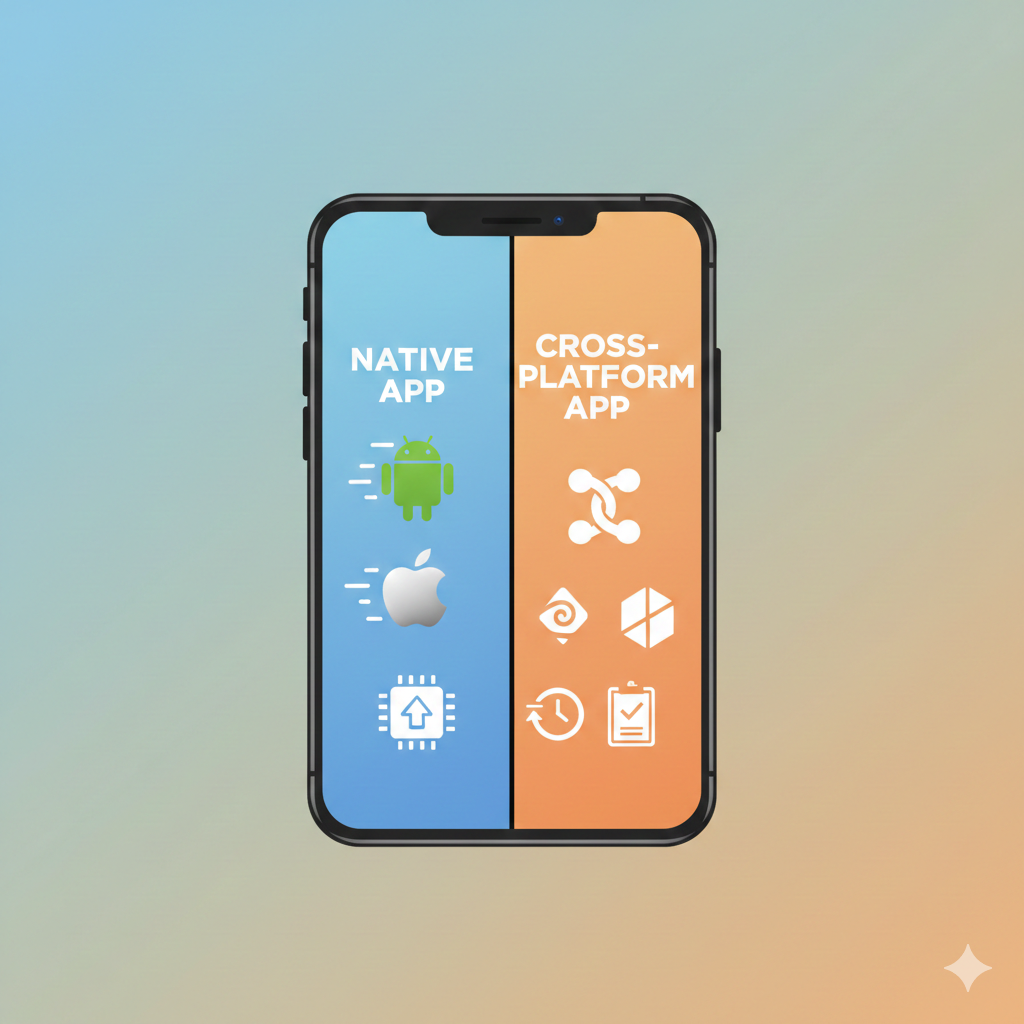
The Straight Answer You’re Looking For
Here’s the deal:
Native apps give you better performance and total control over your app’s experience but they’ll cost you more money and time.
Cross-platform apps are faster and cheaper to build since you’re writing code once for both iOS and Android but you’re trading off some performance and flexibility.
The right choice? It comes down to what your app actually needs to do, how much you can spend, when you need to launch, and where you see this thing going in two years.
by the time you finish this guide, you’ll know exactly which route makes sense for your app. Even if you’ve never written a line of code in your life.
Why This Decision Feels So Damn Confusing
Let me guess what you’ve been hearing:
Your developer friend says “native is the only way to go” while sipping craft coffee and talking about “native performance.”
That agency you talked to keeps pushing cross-platform because it’s “cost-effective” (translation: easier for them).
Someone mentioned React Native. Another person swears by Flutter. Your cousin’s boyfriend codes in Swift. And you’re thinking… what language are these people even speaking?
Everyone ends their advice with “well, it depends” — and then doesn’t explain what it depends ON.
Sound familiar?
Look, here’s why everyone’s so vague: they’re either trying to sell you something, or they genuinely don’t know your specific situation well enough to give you a real answer.
By the end of this article, you’ll have that answer.
What Is Native App Development?
When people say “native,” they mean building your app specifically for one platform at a time.
Want an iPhone app? You build it using Apple’s tools and languages (Swift, mostly).
Want an Android app? You build a completely separate app using Google’s tools (Kotlin or Java).
Think of it like this: it’s like writing a book in English for Americans and then writing a completely different book in Spanish for your Mexican audience. Different languages, different cultural references, different everything — but both versions are crafted specifically for their readers.
Apps you use every day that are native:
- Most of Instagram’s core features
- The original WhatsApp
- Pretty much every app that came pre-installed on your phone
Here’s what native does NOT mean: it doesn’t automatically mean “better.” It just means the app was built to speak directly to your phone’s operating system without a translator in the middle.
What Is Cross-Platform App Development?
Cross-platform is the “write once, run everywhere” approach.
You build your app using a framework like React Native or Flutter, and that code gets converted to work on both iOS and Android. One codebase, two apps.
Going back to our book analogy: it’s like writing your book in one language and using a really good translation service to create versions for different countries. The core story is the same, but there’s a layer between you and the final reader.
Why startups love it:
- Half the development time
- One team instead of two
- Cheaper to build
- Faster to market
Why agencies push it:
- Easier to staff projects
- Faster delivery = happier clients (initially)
- Less complexity to manage
Apps that work great with cross-platform:
- MVPs you need to test quickly
- Content-heavy apps (news, blogs, simple eCommerce)
- Early-stage startups burning through runway
- Internal business tools
The Real Differences Between Native and Cross Platform Apps
Let me break this down in a way that actually matters to your decision:
Performance:
- Native: Runs directly on your phone, no middleman
- Cross-platform: Has a translation layer, slightly slower
Cost:
- Native: You’re paying for two separate development teams
- Cross-platform: One team, roughly half the cost upfront
Time to Build:
- Native: Longer — you’re building everything twice
- Cross-platform: Faster — build once, deploy twice
How It Looks:
- Native: Feels exactly like an iPhone app on iPhone, Android app on Android
- Cross-platform: Might feel slightly “off” to power users
Device Features:
- Native: Full access to everything (camera, Bluetooth, sensors)
- Cross-platform: Most things work, but new features take longer to support
Updates & Maintenance:
- Native: Fix bugs in two separate codebases
- Cross-platform: Fix once, works everywhere (usually)
App Size:
- Native: Leaner, smaller file size
- Cross-platform: Slightly bigger because it includes extra code
Scaling:
- Native: Built to grow
- Cross-platform: Can scale, but might need rewrites for complex features
Here’s what matters: these aren’t just theoretical differences. They have real-world impact on your users and your wallet.
Performance: Will Your Users Actually Notice?
Let’s cut through the BS.
When users WILL notice:
- Gaming apps with heavy graphics
- Apps with complex animations
- Camera-heavy apps with filters and processing
- Real-time GPS tracking apps
- Apps that do heavy calculations on your phone
When users WON’T notice:
- Reading content
- Browsing products
- Social media scrolling
- Form submissions
- Simple interactions
I’ll be straight with you: if you’re building a business app where people are reading articles, buying products, or filling out forms — the performance difference between native and cross-platform is basically invisible to users.
Where you run into problems is when you scale. That content app that worked fine with 1,000 users? When you hit 100,000 users with complex features, those performance gaps start showing up.
The real takeaway: For most early-stage apps, performance differences are negligible. It’s when you go complex or massive that native starts pulling ahead.
The Cost Confusion: Which Is Actually Cheaper?
Everyone focuses on upfront cost. Let me show you the full picture.
Initial development:
- Cross-platform: $30k-$80k for a solid MVP
- Native: $60k-$150k for the same app on both platforms
Looks like an obvious choice, right? Hold on.
Long-term costs people forget about:
With cross-platform:
- Framework updates that break your app
- Finding developers who know that specific framework
- Workarounds for features that don’t work smoothly
- Potential rebuild when you outgrow the framework
With native:
- Two separate teams (or at least two skillsets)
- Double the bug fixing effort
- Feature parity challenges (keeping both apps in sync)
Here’s the truth bomb nobody tells you: Cross-platform is cheaper upfront, but it’s not always cheaper long-term.
I’ve seen startups save $40k going cross-platform, then spend $80k two years later migrating to native because they hit a wall.
I’ve also seen companies build native from day one and waste six months when they could’ve validated their idea in two months with cross-platform.
The cost question isn’t “which is cheaper?” — it’s “which cost structure matches my timeline and growth plan?”
Time to Market: Speed vs Stability
Let’s talk deadlines.
If you need to launch fast: Cross-platform wins. You can have an MVP in the App Store and Google Play in 2-3 months versus 4-6 months for native.
Why this matters for startups:
- Faster investor demos
- Quicker user feedback
- Testing ideas before burning cash
- Meeting fundraising deadlines
But here’s the catch: That speed comes with technical debt. You’re moving fast, but you might be building on a foundation that needs work later.
When to prioritize speed:
- You’re pre-product-market fit
- You need to validate an idea
- You’re bootstrapped and need revenue NOW
- Competition is launching soon
When NOT to prioritize speed:
- You’re in a regulated industry (finance, healthcare)
- Your app’s core value is performance
- You’ve got funding and time to build right
- You’re entering a mature market where quality matters more than being first
Think of it this way: cross-platform gets you to market for the sprint. Native builds you up for the marathon.
UI & User Experience: Will People Know the Difference?
Here’s a question I get all the time: “Will my users know I didn’t build native?”
Short answer: most won’t consciously notice. But they’ll feel something.
What native gives you:
- Buttons that behave exactly like iPhone buttons on iPhone
- Gestures that feel right (swipes, long-presses, animations)
- Design that follows Apple or Google’s guidelines perfectly
- That intangible “this feels like it belongs on my phone” vibe
What cross-platform gives you:
- Consistent experience across both platforms
- Your brand’s look and feel, not Apple’s or Google’s
- “Good enough” for 90% of use cases
- Slightly generic feel to power users
Real talk: If you’re building a consumer app where user experience is your differentiator — like a dating app, a meditation app, a premium productivity tool — native gives you that extra polish.
If you’re building a B2B tool, an internal app, or something where functionality matters more than feeling like a “real” iPhone app? Cross-platform is totally fine.
The brand question: Some companies actually WANT the same experience everywhere. They don’t want their app to look like an iPhone app on iOS and an Android app on Android — they want it to look like THEIR app, period. Cross-platform helps with that.
Device Features: The Big Confusion Zone
This is where a lot of people get tripped up.
Your phone can do a lot: use the camera, connect to Bluetooth devices, access your location, read NFC tags, run in the background, use biometric sensors.
Here’s the reality:
With native: You get instant access to everything, the moment Apple or Google releases it. New iOS feature drops? You can use it the next day.
With cross-platform: You can access most features… eventually. The framework needs to build support for new features first, which can take weeks or months.
Practical examples:
Camera apps: If you’re building something like Instagram or a document scanner, go native. You need full camera control, and cross-platform limitations will frustrate you.
Bluetooth devices: Connecting to fitness trackers, smart home devices, or medical equipment? Native gives you fewer headaches.
Background services: Need your app to track location or sync data while users aren’t actively using it? Native handles this better.
Push notifications: Both work fine, but native gives you more control over timing and behavior.
The honest truth: Cross-platform frameworks have gotten REALLY good. React Native and Flutter support most features most apps need. But if your entire app is built around one specific device capability, don’t risk it — go native.
Scaling & Future Growth: Think Past Your MVP
Here’s the question that keeps founders up at night: “What if I choose wrong and have to rebuild everything?”
Let me give you the realistic scenarios.
Starting cross-platform, going native later:
This happens ALL THE TIME. Uber, Airbnb, and countless others started with or heavily used cross-platform approaches before moving features to native.
Can you do it? Yes. Will you have to rebuild? Parts of it, yes. Is it the end of the world? No.
The transition typically looks like this:
- Start with cross-platform MVP
- Get traction and revenue
- Identify performance bottlenecks or feature limitations
- Gradually move critical features to native
- Sometimes keep simple screens cross-platform
Starting native, staying native:
This is the “build it right from day one” approach.
Pros: No painful migrations later, scales smoothly Cons: Takes longer, costs more, might be overkill for your needs
The hybrid approach (smart startups do this):
Build your core experience native, use cross-platform for secondary features. Or build native for your primary platform (where most users are) and cross-platform for the other.
What happens when you scale:
At 10,000 users: Both work fine At 100,000 users: Cross-platform might show cracks At 1,000,000 users: You’re probably moving critical stuff to native
But here’s the key: by the time you have a million users, you have revenue to fund the transition. Starting native when you have zero users is premature optimization.
Maintenance & Updates: The Long Game
Let’s talk about what happens AFTER you launch.
When Apple or Google updates their OS:
Native: Your app might break, but you have direct access to fix it Cross-platform: You’re waiting for the framework to update, THEN you update
I’ve seen cross-platform apps break for weeks after an iOS update because React Native needed time to catch up. That’s brutal for your users and your reputation.
Bug fixes:
Native: Find bug on iOS, fix it. Find bug on Android, fix it separately. Cross-platform: Find bug, fix it once, works everywhere (ideally)
But here’s the catch with cross-platform: sometimes a fix for iOS breaks Android, or vice versa. Then you’re adding conditional code, and your “single codebase” advantage starts eroding.
Adding new features:
Native: Build it twice, takes twice as long Cross-platform: Build it once, faster to ship
This is where cross-platform shines long-term. If you’re constantly iterating and adding features, that single codebase saves you months of development time.
Dependency hell:
Cross-platform apps rely on third-party libraries for lots of functionality. When those libraries stop being maintained, or conflict with each other, or break with new OS versions — you’ve got problems.
Native apps use libraries too, but you’re usually closer to the metal with fewer layers of abstraction.
Security: Is One Actually Safer?
Let’s clear up some myths.
The truth: Your backend security matters WAY more than whether you built native or cross-platform.
Most security issues come from:
- Poorly secured APIs
- Weak authentication
- Data not encrypted in transit
- Cloud infrastructure vulnerabilities
- Social engineering and phishing
Not from whether you used Swift or React Native for your frontend.
That said, there are some differences:
Native apps:
- Code is compiled and harder to reverse-engineer
- Direct access to platform security features
- Better control over secure storage
Cross-platform apps:
- JavaScript-based frameworks are easier to reverse-engineer
- Additional code layers mean more potential vulnerabilities
- Dependent on framework’s security practices
When security REALLY matters:
If you’re building a banking app, a healthcare app, or anything handling sensitive data — go native. Not because cross-platform is inherently insecure, but because:
- Regulators and auditors prefer it
- You need total control over security implementations
- The stakes are too high to depend on a third-party framework
For most apps? Your backend security, HTTPS, proper authentication, and secure data storage matter infinitely more than native vs cross-platform.
Developer Availability & Hiring: The Reality Check
Let’s talk about actually building this thing.
Finding developers:
Native iOS (Swift): Smaller talent pool, higher rates ($100-$200/hr) Native Android (Kotlin): Slightly larger pool, similar rates React Native: HUGE talent pool, lower rates ($75-$150/hr) — lots of web developers can jump in Flutter: Growing fast, mid-range rates ($80-$160/hr)
The agency vs in-house question:
Agencies: Almost always push cross-platform because it’s easier for them to staff and deliver quickly. Not necessarily what’s best for YOU.
In-house teams: Prefer what they know. Your Swift developer will tell you to build native. Your React developer will push React Native.
Vendor lock-in risks:
Here’s something people don’t talk about enough: if you build with a specific cross-platform framework and your development shop knows only that framework, you’re locked in.
What happens if:
- They raise prices
- They go out of business
- The framework loses popularity
- You want to switch teams
With native, any iOS or Android developer can jump in. With cross-platform, you need someone who knows THAT specific framework.
The hiring cost reality:
Building native means hiring (or contracting):
- iOS developer(s)
- Android developer(s)
- Potentially separate designers for each platform
Building cross-platform means:
- One development team
- Shared resources
- Easier coordination
For early-stage startups burning through cash, that difference is massive.
Which One Should YOU Choose? (Your Decision Framework)
Okay, enough theory. Let’s make this practical.
Choose NATIVE if:
✓ Your app’s core value is performance (gaming, AR, heavy media processing) ✓ You’re building for a regulated industry (finance, healthcare) ✓ User experience is your main differentiator ✓ You need cutting-edge device features immediately ✓ You have the budget and timeline (6+ months, $100k+) ✓ You’re planning to scale to millions of users ✓ You’re building for one platform first anyway
Choose CROSS-PLATFORM if:
✓ You need to validate an idea quickly (2-3 months) ✓ You’re pre-product-market fit ✓ You’re bootstrapped or have limited budget (under $80k) ✓ Your app is content-heavy or form-based ✓ You want feature parity across iOS and Android ✓ You’re building an internal tool or B2B app ✓ Time to market is critical ✓ Your developer team knows React/JavaScript
Budget-based scenarios:
Under $50k: Cross-platform, no question. Build an MVP, test it, get revenue.
$50k-$100k: Cross-platform for full-featured app OR native for one platform only (start with iOS if your users are there).
$100k-$200k: Native for both platforms OR premium cross-platform with heavy optimization.
$200k+: Native, possibly with hybrid approach for secondary features.
App type recommendations:
SaaS/productivity: Cross-platform works great eCommerce: Cross-platform is fine unless you’re competing with Amazon Social media: Start cross-platform, move to native as you scale Dating apps: Native — UX is everything Games: Native, especially for graphics-heavy games Fintech: Native for trust and compliance Healthcare: Native for security and regulations Internal tools: Cross-platform, save the money
Busting the Myths You’ve Probably Heard
Let me clear up some BS that’s floating around.
Myth 1: “Cross-platform apps are always low quality”
False. Facebook, Discord, and Bloomberg all use React Native for significant parts of their apps. Quality depends on your developers, not your tech stack.
Myth 2: “Native apps are always crazy expensive”
Not necessarily. If you’re building for ONE platform (just iOS or just Android), native isn’t that much more expensive than cross-platform for both.
Myth 3: “Big companies don’t use cross-platform”
Wrong. Alibaba, eBay, and Microsoft use Flutter. Shopify, Tesla, and Walmart use React Native. Big companies use what works for their use case.
Myth 4: “You can’t scale with cross-platform”
You can. You just might need to migrate some features to native later. That’s not failure — that’s smart iteration.
Myth 5: “Native means better performance in all cases”
For a form-based app or content reader, you won’t notice the difference. Performance advantages show up in specific scenarios, not everywhere.
Myth 6: “Cross-platform means your app will look the same on iOS and Android”
Good frameworks let you customize per-platform. You can make your iOS app feel like iOS and your Android app feel like Android, even with shared code.
Real-World Examples (Because Theory Only Goes So Far)
Apps that started cross-platform:
Instagram: Started with cross-platform elements, gradually went native as they scaled.
Airbnb: Used React Native extensively, then moved to native for better performance. They don’t regret starting cross-platform — it got them to market faster.
Discord: Still uses React Native for lots of features. Works great for millions of users.
Apps that went native from day one:
Spotify: Built native, still native, performance matters for music streaming.
Pokemon GO: Native because AR and location tracking are core features.
Robinhood: Native for security, trust, and real-time trading performance.
Smart hybrid approaches:
Uber: Native for driver and rider apps (core experience), cross-platform for some internal tools.
Walmart: Uses React Native for some features, native for others.
The pattern? Start with what gets you to market. Evolve based on real user needs, not theoretical perfect architecture.
My Final Take: Stop Overthinking This
Here’s what I wish someone had told me when I was stressing about this decision:
Native isn’t “better.” Cross-platform isn’t “worse.” They’re tools with different trade-offs.
The wrong choice isn’t choosing native over cross-platform or vice versa.
The wrong choice is:
- Spending six months building native when you needed to test your idea in two months
- Going cross-platform for a performance-critical app and hitting walls later
- Choosing based on what’s trendy instead of what your app actually needs
- Letting a developer or agency choose for you without understanding why
The right choice is the one that:
- Gets your app to users when you need it there
- Works within your actual budget
- Matches your technical requirements
- Supports your growth plans
Most successful apps started “imperfectly.” They launched fast, learned from users, and evolved their tech stack as they grew.
Your job isn’t to build the perfect app from day one. It’s to build something people want, then improve it.
Start with this question: What happens if I spend six months building the “perfect” native app and nobody wants it?
Versus: What happens if I launch a “good enough” cross-platform app in two months, get real users, and then invest in making it better?
For most of you reading this, the second option is smarter.




[…] technical decision should support that strategy. If your developer says “we should use this framework because […]